I thought this was old news, but apparently not.
Newspapers are a long-forgotten medium in our modern world. But I happened to spot a copy of the New York Times in a moment of boredom and realized it’s still a unique source of connection to the world around us.
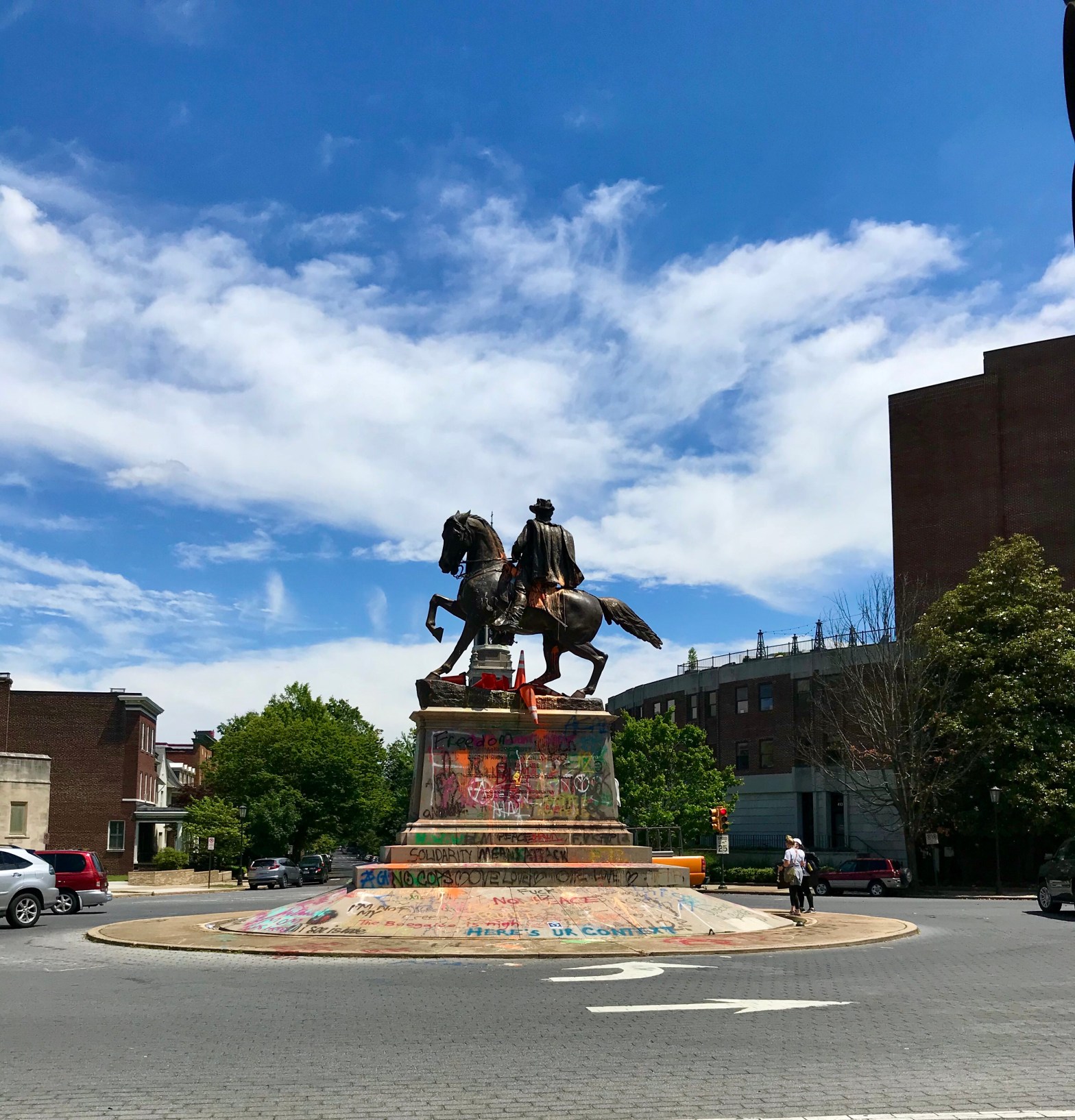
A giant statue of General Robert E. Lee graced the cover of the commentary section that day. It looked so familiar. I could have sworn it was a photo of the one that once stood on Monument Avenue in Richmond and became a living work of art during the protests for George Floyd. I was somewhat surprised to find out that this one was in Charlottesville.
Although different artists made the Lee monuments that used to stand in these two cities, many bronze Confederate statues were manufactured by the same company, with one design being replicated repeatedly and spearheaded by the United Daughters of the Confederacy. This is why so many monuments look identical.
I frequently run in The Fan, Richmond’s nickname for the area that includes Monument Avenue. I loved watching the evolution of the Lee Monument during the protests. I was thrilled when the monument was removed on September 8, 2021, watching the process live on TV. The statue was erected in 1890.

The Enlightening
Recently, as I was sitting and waiting for a meeting to begin, I overheard a conversation where a white man lamented about “erasing history” by removing the Confederate monuments. Someone piped up and agreed with his statement.
I couldn’t keep my mouth shut.
“Um… do they have statures to Hitler in Germany?” I asked.
“Well, no. That would be ridiculous,” he stated.
“Then why would you think honoring someone who actively fought to maintain the dehumanizing of an ethnic group be OK here?” I argued.
“Well, this is different.”
“Is it? I would ask you to try to see the from the perspective of the oppressed.”
“Huh. I’ve never considered that before.”
“Well, maybe you should. I think some aspects of our history should not be honored.”
“But these monuments are tremendous works of art!” he continued.
“But are they really? Think about when these monuments were erected all over the South, especially. It was in the reconstruction era with another push in the 1950s, the height of the Jim Crow era. And all of the monuments looked exactly the same. Same mold. Did you think they perhaps were erected simply to reinforce the fear of the formally enslaved?”
“Oh, wow. I’d never thought about it like that before.”
I had won my case.
Why Speaking Up Matters
There happened to be a person of culture in the room who overheard this exchange. She approached me after the meeting, thanking me for saying something. She felt validated in my defense of the removal of those awful monuments.
“There’s no way it would have gone well if I had tried to explain it to him,” she said.
“Well, sometimes white people have to hear their stupidity from another white person. It makes it more palatable when they are called out on their bullshit, unfortunately. Maybe next time he will reflect a bit before he speaks.”
This exchange was the beginning of a great friendship. All because I dared to speak up.
As much as I have run on Richmond’s Monument Avenue over the years and have observed its legacy of intimidation, I often joked that the only time I was glad to see Stonewall Jackson was on a run because that typically marked our turn back to our cars. Now that turn is no longer marked by that statue.

Next Steps
We aren’t finished cleaning up the legacy of the Confederacy here in Virginia.
In my county, which is outside of the city and far more conservative, a measure to rename two schools in the county from Lee-Davis and Stonewall Jackson was barely passed in 2020. The three “progressive” appointed school board members who helped spearhead the movement were quickly removed by the board of supervisors.
Confederate flags still plague the landscape here. Racism runs deep in Hanover.
There’s a lot to reconcile as a daughter of the South, as I can trace my ancestry to original colonists in Virginia in 1610. However, I plan to be a part of the healing process rather than a carrier of the legacy of abuse. You can, too.
___________
Lead photo of the Jeb Stuart Monument in Richmond by author.
Staying silent equals compliance, and apathy is the enemy of democracy.
We can all work for better equality in this country. Activism doesn’t have to look like protesting in the streets. It’s also simple measures like emailing or calling your representatives. Don’t be afraid to let your voice be heard.
As always, I hope you all are safe and healthy.
 Anne the Vegan
It’s hard to reconcile that you don’t acknowledge happened. Ole dude is quick to say a statue of Hitler would be ridiculous, but in the US, where its bad history isn’t acknowledged, well why not have them up? Or it’s considered “woke” which again means the past has to be acknowledged for what is and they would rather not do that.
LikeLiked by 1 person
Indeed.
LikeLike