Guilty as Charged

The jury got it right. Why does it feel like for the first time, a policeman will actually be held accountable for his wrongful actions? As my daughter says, the police are here to enforce the law, but they are not above it. I’m so relieved. I’m not joyous. I’m just able to breathe. This wasn’t justice, though. It was merely accountability. Now we await sentencing and appeal.

Is this a tipping point in proving that Black lives matter? One can hope. However, I feel like we took 3 steps forward in the fight for social justice, and now there will be a major push back from conservatives who want to maintain systems of suppression that have existed for so long. Just like once we elected Democratic Senators in traditionally Republican Georgia, the Republican state lawmakers quickly passed laws limiting voting rights. As great as this verdict is, I’m waiting for the blow back. 

It’s really difficult to fathom the mindset of anyone who now thinks our country is going to hell because someone in uniform was held accountable for murdering someone. Abuse of authority is wrong. Period. 

Even in the conservative county where I live, it is rumored that the police here will be out in “full force” targeting Black drivers to pull over in the next few days. Or, in other words, doubling down on their normal. How can one begin to fathom how doing this is justified? Punishing everyone who looks like George Floyd for the rightful conviction of a man who murdered him? 

We have a corridor along a major road that leads from the East End of Henrico into Hanover County. Cops sit there in pairs and pull people over for the most minor offenses, hoping they will find something bigger when they pull their records. I’ve seen it with my own eyes, as I used to do home health in that area. My husband used to be friends with a sheriff who used to brag about how many people he’d arrest using this tactic, almost always Black. 

When I did home health, my best friend from grad school was my mentor. We had a couple of weeks together with many hours in the car and with lots of time to talk. One of our discussions took my breath away. We were talking about how we were raising our kids. We both have girls, but she has a son as well. She and her husband had to give him “the talk” about how to not get killed if he got pulled over. I had never thought about the dangers of being pulled over by the police. My biggest fear was getting a ticket. Her biggest fear, especially for her son, is that they don’t make it out alive. Until this conversation, it never occurred to me how different our realities are, just because she’s Black. We have the same degrees. We have the same job. We are both happily married and own our homes. But in this, we are not the same. It’s not fair. 

I keep thinking about that scene in A Time to Kill, the screen adaptation of John Grishom’s book. Have you seen it? Starring Matthew McConaughey and Samuel L. Jackson. In the closing arguments of the trial, Matthew’s character has the jury close their eyes as he describes what happened to a little girl as she walked home, how she was abducted, raped, and tortured by two white men. He then asks the jury to picture that she is white, and everyone gasps, and finally understands why the father shooting her rapists was justified. That’s what white folks need to do. Don’t dismiss a tragedy for a black family because they don’t look like you. Think about how you would feel in their situation. Feel their pain. Feel their fear. Feel their frustration with a system designed to oppress them. 

Furthermore, the meritocracy we subscribe to as Americans is all fine and dandy, however, the bootstraps are significantly longer for people of color and the poor. What we hold ideally as liberty and justice for all, that anyone can work hard and succeed, isn’t reality. It’s at best a means for hope, which we honestly can’t survive without. It’s at worst a government scheme designed to kill dreams. That is the truth. 

Our society deteriorates when we dehumanize our neighbors. Excessive brutality by police is terrorism; targeting people of color for this is akin to genocide. To make a conscious choice to target a certain group, harass them for minor offenses, and kill over something as benign as a fake $20 bill or a hanging air freshener, while simultaneously peacefully arresting white men who committed mass murder, what does that say about our police system? And the after-the-arrest looking back to prior offenses or someone’s lifestyle to justify violence against them is also wrong. People are people. We are all human and deserving of respect. A white person’s life is not more valuable than someone’s of color. 

Is there power in this verdict? I hope so. I hope this verdict is the beginning of reforming a system that doesn’t work for everyone. And although I have hope, I also fear that this is merely a token gesture in the big picture, and no real change will come from it. Let’s not let that be the case. 

Black lives still matter. 

Last year at Marcus-David Peters Circle in Richmond on Monument Avenue.

What can we do right now? Contact your senators and let them know you support the George Floyd Justice in Policing Act which has already passed the house. This offers fewer protections from prosecution for law enforcement while also making it clear what acts will not be tolerated under police control, including sexually assaulting people in custody. Read the linked article to find out more.

Don’t know how to reach your senators? Find out here.

Other resources for the movement:

General information

ACLU

The struggle to create wellness is made more difficult when we face unfairness. How can we feel well in a stressful, uncertain world? Discrimination happens in policing, it happens in retail, it happens in voting, it happens in healthcare, it happens in schools, it happens in church. No one in authority should abuse their power. We need real change now. How did you feel when the verdict was announced? As always, I hope you all are safe and healthy.
Blue Ridge Half Marathon 2021: Race Recap

The space between getting ready the morning of a race and starting is usually met with the same thought: this was stupid. It’s a typical race anxiety cycle thought process. This was my mental place before the Blue Ridge Half Marathon. It wasn’t in a bad, angry-with-myself way. This was in a “my friends have all told me how hard this race is and I’m about to climb two mountains” way. I just had to laugh and roll with the punches. 

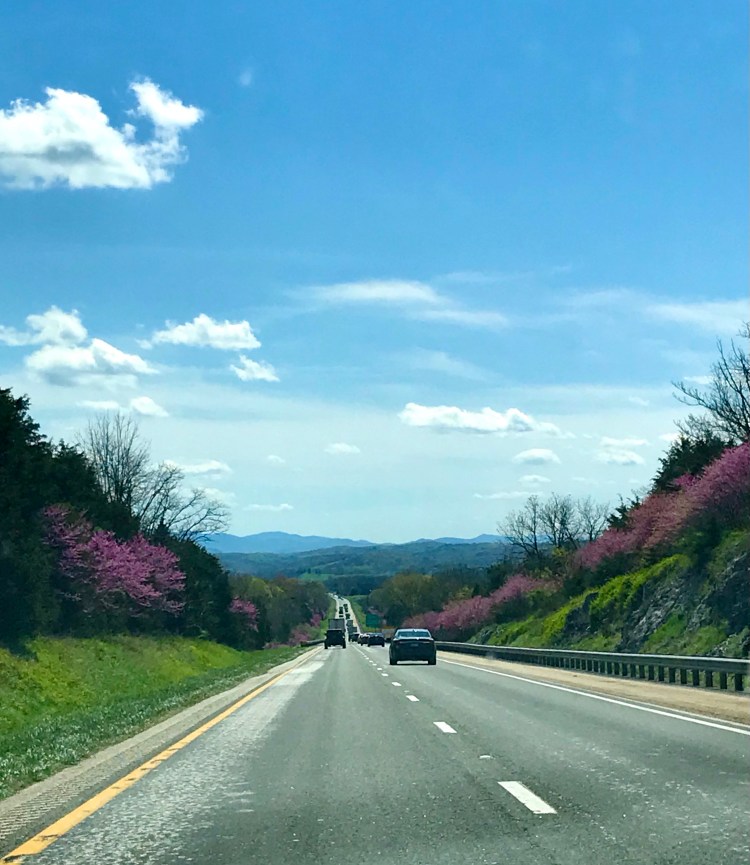
The view from I-81 as Patty drove us into Roanoke. Pictures don’t do it justice!

My best friend Patty and I drove up the afternoon before the race, checking out Roanoke and all of its beauty. It’s a gorgeous city! Even though I did one of my clinical rotations in PT school in the rehab hospital at Roanoke Memorial, I forgot how pretty it is. We wondered if people who live there ever get tired of the spectacular mountain views. We even rode up to the top of Mill Mountain to see the star and take some pictures on the very road we would both run the next day. 

The Roanoke Star on top of Mill Mountain. It lights up at night!

The race expo was small, but organized. There were lots of good giveaways from all of the sponsors. I loved the race shirt, which has a really cool retro 80’s vibe. There was free ice cream, too! 

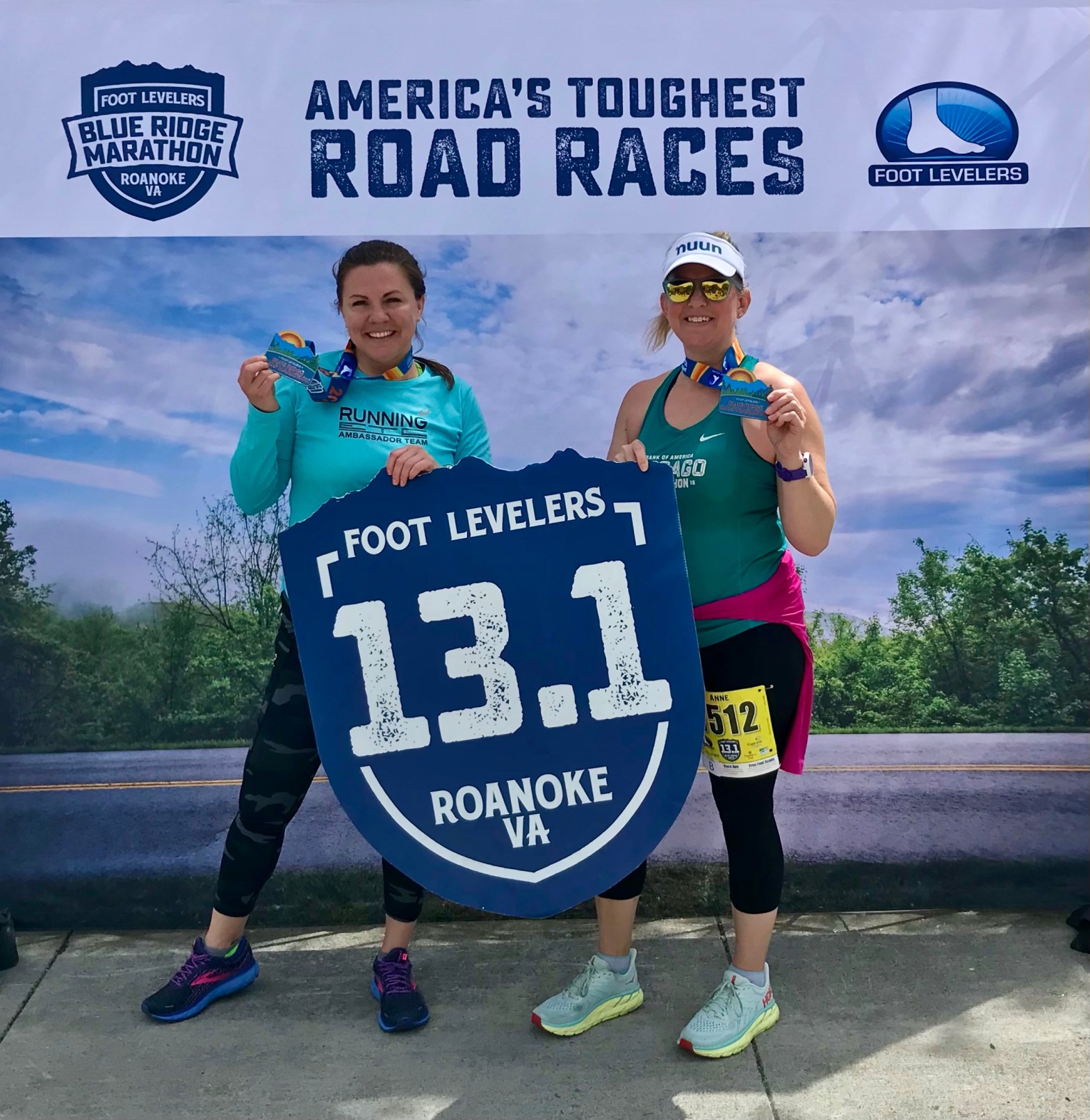
Race shirt and medal.

The morning of the race, we found ample free parking near the start. They had staggered start times for all 3 races, ensuring that the staging areas would not be too crowded under current state Covid guidelines, and there were plenty of porta potty areas with actual hand washing stations. The weather was perfect: partly cloudy, low humidity, and temps in the 40’s with highs topping out in the 60’s. 

In my corral before the race.

According to my bib, I lined up to start in corral B. My Richmond friends were in corral U, and Patty would start the 10k a bit later. How I ended up in that corral, I don’t know, because I’m nowhere near an 8 minute mile runner! But I was grateful for the early start. Once we were out of downtown proper, we began the journey straight up Mill Mountain, all the way to the star. 

My pre-race feelings of stupidity were confirmed by the end of the first mile, when I quickly realized that although I had trained to run this distance, my choice to neglect the recommended serious hill training was a poor one! I mean, I’d run hills, but not mountains! I was already taking walk breaks, and I was in good company. Sometime during the second mile, one of my Richmond friends stopped to walk with me and determined that this would not be her race. (She ended up finishing in her goal time, anyway!) And shortly after that, I struck up a conversation with another runner, and we ended up running the rest of the race together. 

Suddenly, the most humbling of races became fun again! We basically ran all the flats and downhills and walked the uphills for the rest of the race. We discovered that we are both ambassadors for this race! It was great to run with someone who was not a newbie to the Blue Ridge half like me. She confirmed what my friends told me: that, indeed, the uphill on Peakwood was so steep, there are points where you could reach out to the road ahead of you and touch it while still standing. It’s true! And as steep as the uphills were, the downs were equally so. Trying to stay upright for those was a battle for eccentric muscle control. So it was either go all out, allowing the hill to guide your speed, or walk. We took a cue from Frozen and let it go. Besides, Patty always says to never waste a downhill! And nothing passes the time more quickly than exchanging all of your best stories with someone new! So grateful for Jenn’s company on the course!

The mimosa stop at the bottom of Mill Mountain.

The view from the top of Mill Mountain at about mile 3 was spectacular. The downhill from that was spicy, but such a relief from the incline we just ascended. And waiting at the bottom? Mimosas. We then spent some time running along the beautiful and fairly flat Roanoke Greenway, and then the climb to the top of Peakwood Mountain began. The houses through these areas were so amazing! I did find points where I truly understood the idea of reaching out to touch the road in front of you during that climb. At the top of the second mountain were all the snacks, anything from fruit to pretzels to chocolate to Skittles, and there was also champagne and strawberries! We made our way an even spicier downhill and back downtown to the finish, stopping along the way to take pictures with a mannequin and to enjoy some treats from people in the neighborhood, including mustard packets and shots of Coca-Cola!

With my new friend Jenn sipping champagne!
With the mannequin on the course.

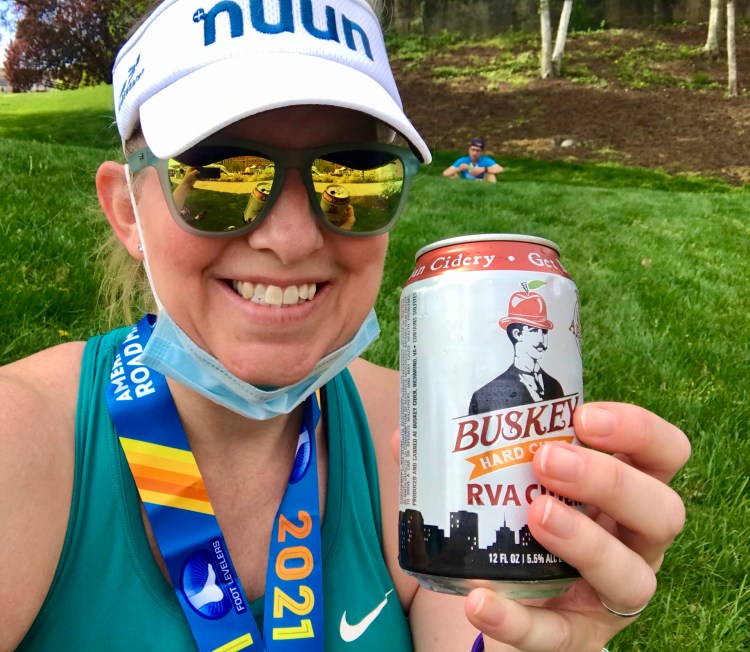
The post-race event was well organized with plenty of space to socially distance. Our names were called as we crossed the finish, which is always fun! People were generally compliant with the mask mandate, and the Blue Ridge Marathon even provided fresh, disposable masks at the finish. Instead of someone hanging your medal on you, you picked it up from a table. Post-race food was pre-packaged to limit exposure. And post-race free beers were from local craft breweries and in cans instead of from kegs in the name of safety. I enjoyed my brew from Three Notch’d, which happened to be a Buskey cider from my native RVA. 

Enjoying my well-earned Buskey cider after the race!

I’ve got to say, although the Blue Ridge Half Marathon lived up to its name as America’s Toughest Road Race, I would totally run this one again. The course is beautiful, even if it’s challenging, the race is very well organized, and the support on the course is outstanding! The evening of the race, there was an outdoor concert for participants, and you could also register for a coffee and donut fueled “slow-K” on Sunday, a walking 5k along the Roanoke greenway. This was definitely a race to check off my bucket list! And, y’all, as tough as the half was, there were marathoners and even about 100 double marathoners! They are a special kind of crazy, and I mean that in the best, only runners could understand, way!

I’m so very grateful to run a real, in person, race again! I hope this means that more live events will happen this year. I’m also super grateful to be fully vaccinated so that I have more confidence in safely traveling and participating in events like this. Many thanks to the Blue Ridge Marathon for asking me to be a part of their ambassador team and to the event planners for managing to adapt their race to the evolving Covid restrictions and still make it a fantastic event. I will be back next year!

Today, my legs are more sore than if I’d run a fast and flat full marathon. It’s crazy! Have you been able to run in a live event yet this year? If so, how was it? If not, would you be comfortable yet participating in a live event? I’d love to hear your thoughts! As always, I hope you all are safe and healthy. 

The Pollening

In Virginia, we have a series of sub seasons before we really get into the full swing of the weather we are actually supposed to be experiencing. Spring is no exception. We’ve got early spring, second winter, spring of deception, third winter, etc… and our current season? The pollening. It sounds like a campy horror movie. 

Pollen season always happens so suddenly, right? I mean, we see the slow transformation from the bleak that is winter. We see that the landscape is beginning to brighten. But it still seems like out of nowhere, all the pine trees decided it was time to reproduce! My favorite local meteorologist, at least, blames this surge of yellow on the pines. 

Ugh. This stuff is everywhere. Fine, yellow silt covering our cars, being inhaled, coating our clothes. It’s as if Mother Nature has cast a yellow filter on our world. Clouds of the stuff waft up from the trees into the breeze, landing on all the surfaces. Light rain brings rivers of pollen that collect in swirling divots. A friend had to brush off the pollen from my scrubs the other day when I sat on a bench outside with one of my patients. And even though we were only out there for about 30 minutes, the stuff had gotten all over my patient’s shoes, too! No surface is off limits, it seems.

One of my favorite stories from Longwood was from the spring semester that I took botany. Now, I only had to take this one plant class for my biology degree since I was in the pre-PT track, but it was certainly memorable. Dr. Scott was our professor, and he was, in true tenured professor form, what one would call eccentric. He was certainly old enough to be considering retirement, and looked like a really nice grandpa. Sure, he was a square on the outside, but once he spoke, he was just, well, different. 

During one of our labs in the spring semester, we went outside on an especially beautiful day. Dr. Scott took in a deep breath, let out an audible sigh, and exclaimed, “You smell that kids? That’s plant sex!” Oy. What a way to make a bunch of college kids feel uncomfortable and silly all at the same time! We erupted into giggles and exasperated groans. 

Would not recommend opening a window during pollenation season…

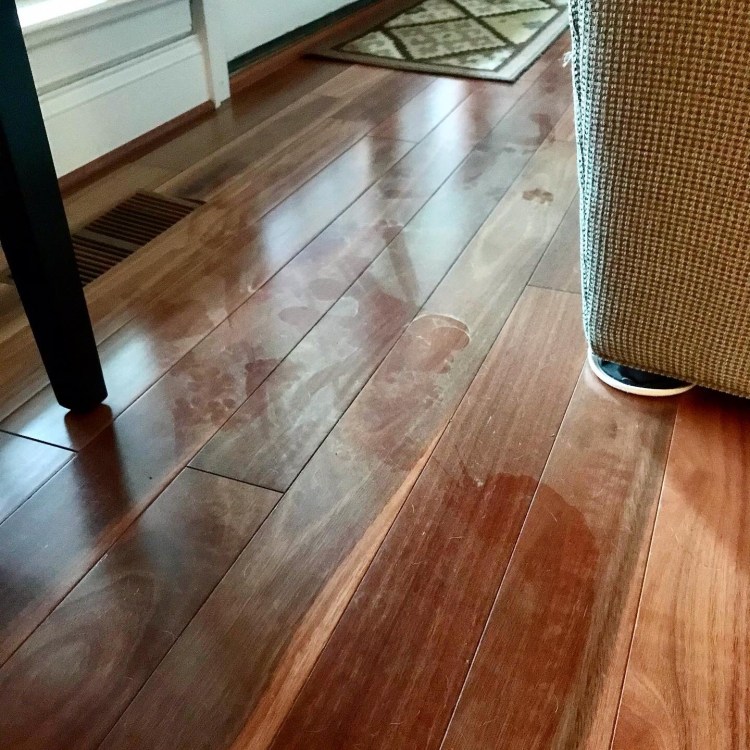
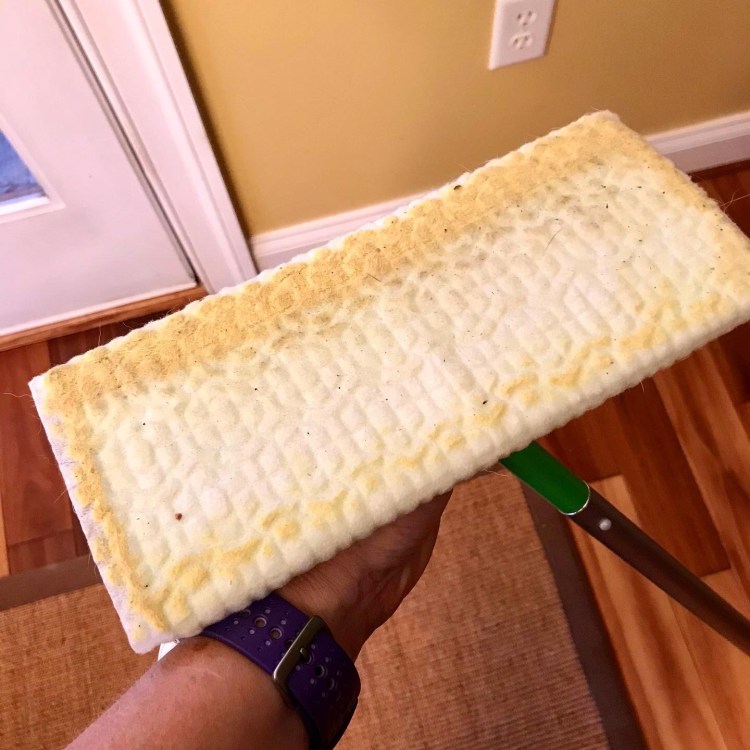
Over the weekend, my daughter opened a window in our house. I kind of forgot about it. But after seeing all the yellow film on my car, I went to look and see if any of the pollen had made it through the screen indoors. Indeed, there was a fine coating on the floor. I should know to not open a window during tree fornication season! Oh, well. Nothing a swiffer couldn’t handle!

Look at all the pollen my Swiffer picked up!

Not only are the trees having fun, but most of the early season flowers that many would consider weeds are in bloom. These are the first foods for our pollinators. Is anyone else just a little more compassionate toward honey bees these days? I used to fear them. Now I try to just sit still and watch them do their thing. Pollen can be good, right?

For my friends in the northern hemisphere, where are you at with regard to spring? Is the pollen as bad where you are as it is here in Virginia? As much as the yellow stuff is annoying, it’s a sign of healthy trees and plants! So don’t fret. It’s just plant sex!

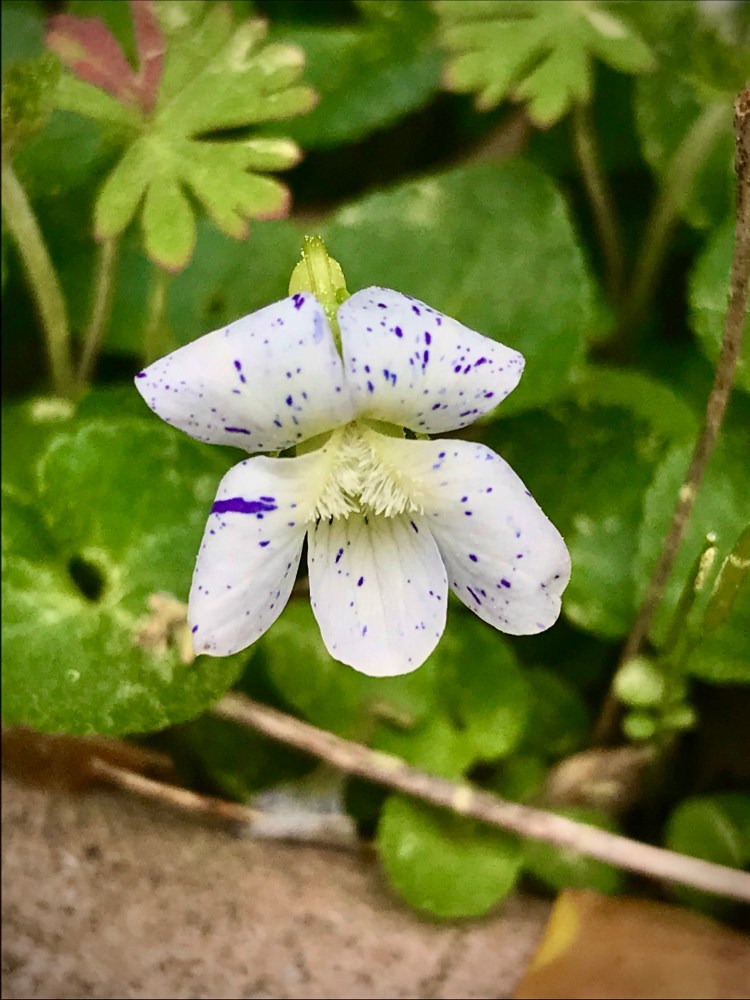
Just one of the color varieties of wild violets we have in my yard.

Don’t get me wrong, I really do love spring! I’m looking forward to putting in a garden soon. If the pollen is wreaking havoc on your allergies, hopefully the rain we got last night has cleared it out! I’m still waiting for my pollen headache to subside. But we should enjoy this time, as Virginia’s worst season will come later this summer… known as Hell’s Front Porch. I’m really not looking forward to that. As always, I hope you all are safe and healthy. 

The Power of the Marathon

Ultramarathons aside, in the world of running, the ultimate test of mental strength and physical fitness is the marathon. Why is running the marathon such a powerful testament to a person’s will and mental toughness? One reason: the pain. We’ll revisit this point in a bit. 

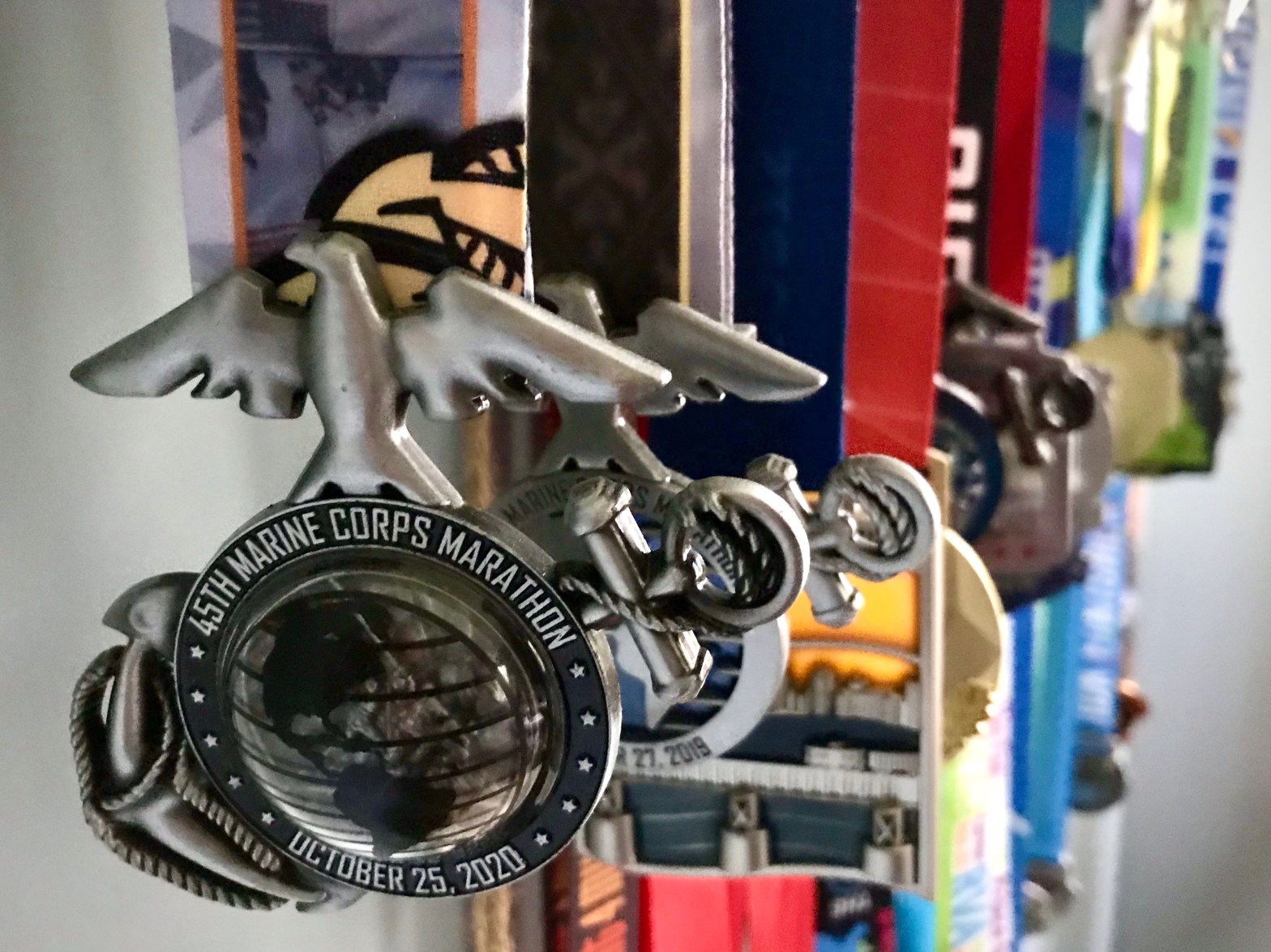
In my wildest dreams, 26.2 miles is a distance I never fathomed I could complete, especially as a new runner. I was the girl who got out of running the mile in gym class. I signed up for my first marathon training team with every intention of dropping to the half. But as I checked off each new distance PR, I started to envision crossing that finish line. I’m fairly certain my mother thought I would die running my first one. Now, I’ve run 8 of them. 

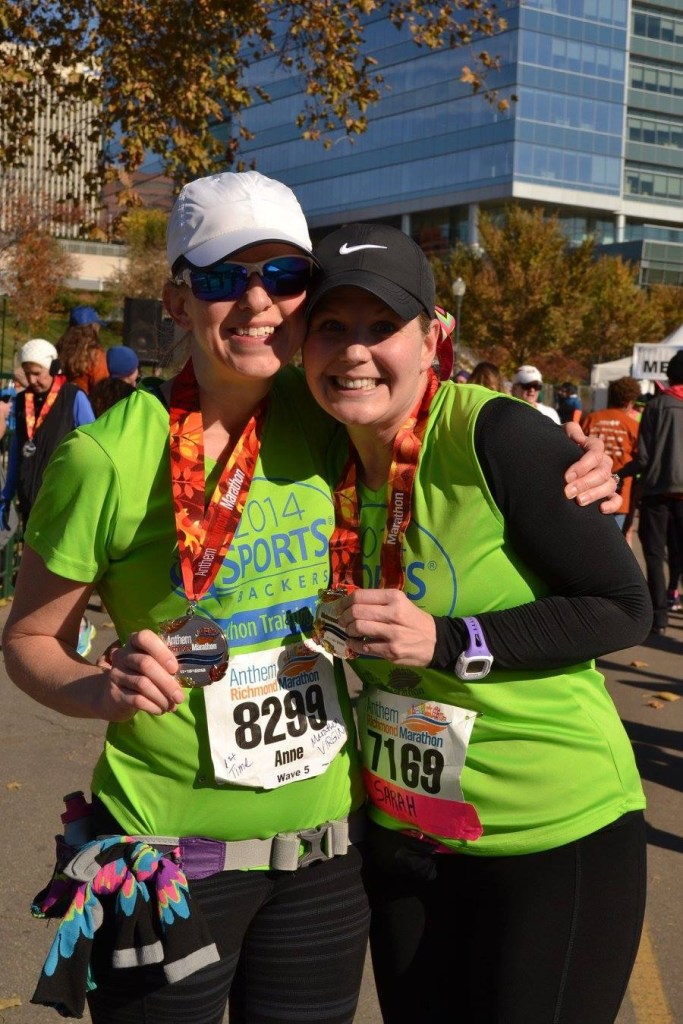
With one of my sole sisters, Sarah, after we ran our first marathon together, which happened to be the Richmond marathon in 2014.

On the first day training for my second marathon, our head coach of the Pink Nation, Blair Just, reminded us: only 1% of the world has ever run a marathon. Marathoners are exceptional. Blair would remind us each week to breathe, relax, and believe that we could do this. This is a mantra I share with my patients often. 

Many years ago, I worked with a patient who had suffered a stroke. She was a relatively young woman to have gone through this, and she was really struggling mentally. She was also a marathoner. I got to use that 1% line with her, reminding her of what a badass she was! If she can get through a marathon, she can do the work to recover from her stroke. She didn’t realize how small of a percentage of the population had actually tackled that distance! It became a mantra for her. Even if I wasn’t working with her that day, I’d catch her eye, and say, “ONE PERCENT” to her. She started to believe she could heal. She left inpatient rehab walking independently.

You can’t just decide one day that you’re going to run a marathon. This race takes planning, training, and discipline. My fall marathon training schedule begins 6 months before my race, and that’s assuming that I’ve kept up with a winter, off-season running routine. 

With my BFF and running partner, Patty, who convinced me that I could run the marathon!

I’ve found running to be hugely beneficial for many reasons. Other than my main means of maintaining my physical fitness, it’s my outlet for mental fitness as well. It’s my time to meditate when I run solo. It’s social time and possibly even a group counseling session when I run with friends. It’s also my way of generating endorphins. Have I ever felt a runner’s high? Yes. Yes, I have. It doesn’t happen every run, but they do happen from time to time! 

But running the marathon distance (or longer) brings its own special experiences, most notably with pain. Yes, the marathon is painful, both during and after the race. But greeting the pain during the race becomes expected, especially after running multiples. Typically this starts for me at about mile 17. If you’re familiar with the Richmond Marathon, this is along Main Street, where you are often greeted by drunk brunchers who will loudly chant your name to cheer you on. On the Marine Corps Marathon course, this is on the National Mall, where you have the distraction of the Smithsonian museums and the threat of the first gauntlet to keep you motivated. 

Even with these distractions, you must let that pain in, acknowledge it, and exist and persist despite it. We have other tools to help combat the pain of fatigued and spent muscles like replacing electrolytes, restoring glucose, taking walk breaks, or pausing to gently stretch, but these don’t take the pain away. You still must face the hurt to finish your race.

Regardless of the course, by the time you get to the final 10k, you just want to be done. Your legs are screaming. Your will is spent. You are questioning your sanity. You may or may not have made a deal with the universe pending your completion of this race. Most competitive marathoners will tell you that this is where the race really begins. I think the best part of the race is in the last couple of miles, because this is where the crowds are usually the biggest and loudest, and you know you will finish. 

With 3 of my friends after we all crossed the finish line of the Richmond marathon in 2015, my third marathon. This photo was taken by our 8k training team coach, Tammy Harrison, who happened to be at the finish line.

Overcoming the pain and crossing that finish line never ceases to amaze me. I experience a huge emotional release after every marathon. My Richmond races are the most special, always finding at least one person I know at the finish to award my medal. Sometimes my husband joins me for the last few miles of a Richmond race. But for all but one, I’ve cried. Not just a few tears, but a sobbing mess of ugly tears. One year, my husband captured video of me as I approached the finish, and you can clearly see me winding up to cry. Last year’s marathon was virtual, and I think I actually shouted expletives in jubilation rather than crying. 

Coaching the Richmond Marathon and supporting my team on the course in 2019, it was crazy to meet my runners near the finish and instantly know what mental space they were in, simply because I had been in all of them at one point or another in each of my own marathons. You can see it in their faces. You can hear it in their voices. You can see it in their gait. Whether injured, delirious and repeating mantras, focused and unaware of how close they were to finishing, or having the best race of their lives, I had been there and knew what to do. Part advisor, part cheerleader, part dealer of salt tabs and band-aids, part medical professional: that was me. Serving in that role was so much fun! Especially watching my runners approach that finish line. I was so happy to witness them realize their dreams! 

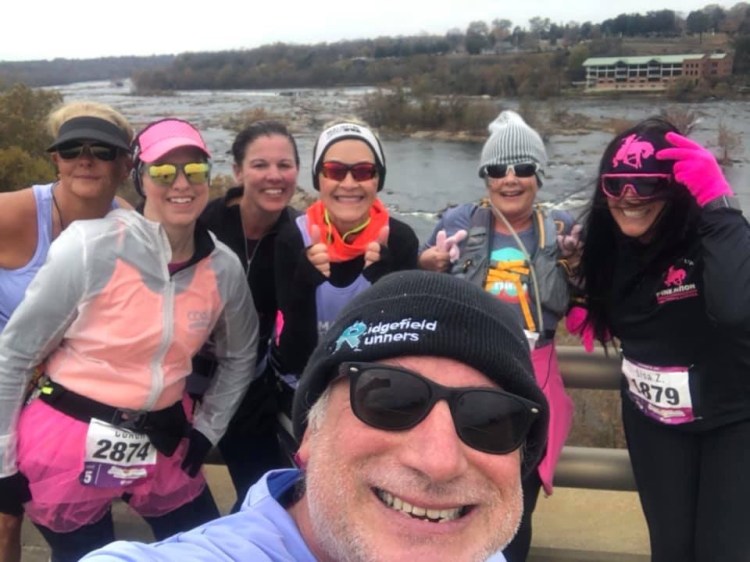
On the course of the Richmond Marathon in 2019. This is on the Lee Bridge around mile 16. Photo courtesy of Eric Nachman, who took the selfie! The Pink Nation asked Kelly (grey hat) and Lisa (cowboy emblem) to join as as coaches for 2020.

The marathon is so much more than a race. It’s a teacher of discipline, resilience, and determination. The quest to complete this goal teaches you how to focus. It teaches you how to have a relationship with pain. The rituals of training bring calm and centering to an otherwise hectic life. Training for this race builds communities. Running these races also teaches you so much about the cities in which you run. 

Mentally, whenever things get tough, I remind myself that I have run not one, but multiple marathons. To choose to put myself through the pain of the race is one thing. To choose to do it again is quite another. I’m either incredibly brave and persistent, or incredibly stupid. You decide. But the brain has a funny way of making you forget how bad the pain gets, just like childbirth. One thing is certain, however. I am part of the ONE PERCENT. And no one can take that away from me. That’s the power of the marathon. 

Have you considered running a marathon? Trust me. If I can do this, so can you. You, too, can be a part of the one percent. With working toward any goal, help is always helpful. In Richmond, we have the resources of the Sports Backers Marathon Training Team to guide us. If running this distance is a dream of yours, I encourage you to find a local running group to train with. As always, I hope you all are safe and healthy. 

My Evolution to Vegan

I’ve picked up quite a few followers since I began this blog journey, and I realized that not all of you know the story of why I decided to adopt a vegan lifestyle. It was initially just my diet, but now includes what I wear, what I use for grooming products, and sometimes even the types of businesses I support.

My journey toward veganism really began as a child. When I was about 9, I remember eating at Quincy’s steakhouse and getting really sick after. I’m not sure if it was food poisoning or a stomach bug, but I did associate getting violently ill with eating those steak tips. I think the last time I actually ordered a steak in a restaurant was to celebrate graduating from high school. We had dinner at The Trellis, which was once a super fancy restaurant in Williamsburg. My best friend at the time was with us, and I knew she really wanted to order the steak, so I did, too, so she wouldn’t feel guilty about ordering the most expensive meal on the menu. 

The book that started it all for me.

By my second semester of college, I became more curious about being vegetarian. I was dating a boy who had been lactose-ovose until he joined the military. He said it was nearly impossible to make it through boot camp and not eat meat. My favorite musician was also vegetarian. So I started reading books about it, and picked up Diet for a Small Planet by Frances Moore Lappé. It’s a fascinating book. I learned how much industrial animal agriculture was harming the planet. Did you know, for example, that it takes 11 lbs of grain to produce 1 lb of beef? That’s crazy inefficient. And she wrote the first edition in 1971. 

After reading that book, I went pescatarian. That was in 1993. I haven’t had red meat or pork since, but I did add chicken back to my diet in 1996. I graduated college early, and I had a semester off before starting graduate school. I worked full time in the mall, and Chick-fil-A was a weakness for me. It actually took a while to adjust to eating that complex protein again. My body just wasn’t used to it anymore. 

So, I considered myself semi-vegetarian for a number of years. This lifestyle was pretty easy. But some interesting things started happening in my thirties. I developed a shellfish allergy, unfortunately. And I’m not really a big fan of fish unless it’s deep fried. So, I was forced to give up seafood. And my husband, who became a crossfit addict, was deeply into eating paleo and counting macros. It seemed like ALL we ate was chicken. I felt conflicted between raising my own flock of chickens and then sitting to dinner and eating the relative of a creature I cared for and loved. So, in 2015, I went lactose-ovose. It was an easy choice for me, and then my husband could have whatever meat he wanted for dinner. 

My last two chickens, Eggo and Ebony

But in 2017, I started seeing a functional medicine chiropractor. I know… why is a physical therapist seeing the enemy? (Yes, it’s true… generally there is competition for similar patients with chiropractors and physical therapists.) But I went to one of his lectures at our local organic market, Ellwood Thompson, and I was impressed by what he had to say about managing chronic inflammation. My asthma definitely fell under this category, and the repeated use of steroids from bronchitis 2-3 times a year and its impact on training for races was getting old. With his help, he led me to transitioning to a vegan diet and finally getting my body’s inflammation under control. 

The test that convinced me was some kind of voodoo magic trick he played involving holding extracts on my abdomen and then performing a manual muscle test on my arms. Dairy was like kryptonite. I thought the test was bullshit, but I decided to give up dairy for a few weeks anyway, and then see what happened when I eventually added it back. 

5 weeks later, my family and I attended a family wedding. There was absolutely nothing there that was remotely vegan, but plenty to build a vegetarian meal. So, I ate all the cheesy, buttery things, and the cake. It was delicious, but my stomach was very clear that it was unhappy. And that was that. I haven’t had dairy or eggs since that day. 

It hasn’t always been easy to eat this way, but it gets easier as more people join the vegan movement. Challenges include cooking meals for my omnivorous family. My husband will never give up meat, so to keep the peace, I do cook meat for them. I really wish they would join me on this vegan journey, but I don’t think they ever will. I make lots of what I call “bridge” meals, for example: pasta with two sauces available, burrito bowls, stir fry, or Mediterranean bowls. Lots of veggies and sides with protein choices to suit everyone. And then there are some nights I really just cook for me, and many more that I really only cook for my family.

Maybe cooking for my omnivorous family makes me a fake vegan, but I don’t feel like I have any other choice. I also share this so that others that think it might be impossible to choose a plant based lifestyle may realize that it might be possible to do so in harmony with others in their family that may not do so.

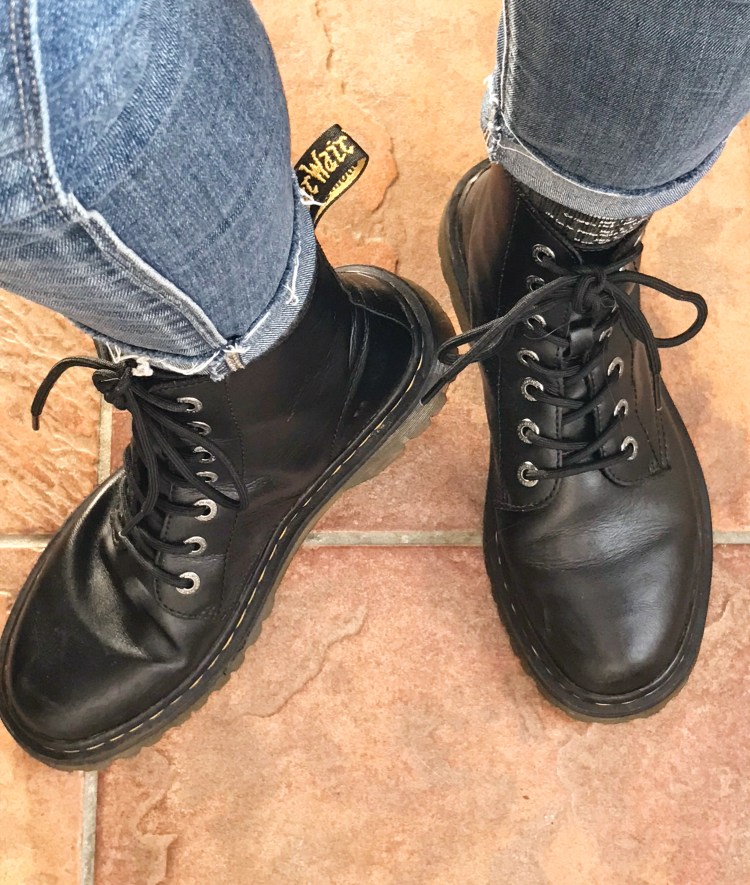
Changing my wardrobe is another story. I did give up using any of my leather items, giving them to my girls or my non-vegan friends. Finding shoes can be especially tricky for the bargain hunter that I am, but occasionally I find suitable items, including some accidentally vegan Doc Martens. 

My 100% man made materials Doc Martens

Physically, I really appreciate not getting sick as often. I wish I could say I’ve lost weight. Initially, I did, but the past year of relative inactivity and fewer trips to the gym due to the pandemic, despite maintaining cardio activity, have taken their toll. I’ve put on 10 lbs in a year. 

Emotionally, the longer I’ve vegan, the more compassion I develop for animals and other humans. I really hate seeing the chicken trucks that make their way to the Tyson processing plant near us. It’s so sad to see them crowded in those cages, freezing cold or blazing hot. I wonder if they are scared. I think about the chickens I cared for, how different their personalities were and how they greeted me when I got home. I don’t regret giving up chicken at all. I never regretted giving up beef or pork. Cows actually cry waiting to be slaughtered. It’s absolutely heartbreaking. 

Following a chicken truck home from work one day. I had to take a picture when we stopped.

There are a plethora of documentaries available on streaming networks, books, and websites that can educate you on the benefits of plant based eating, the facts about the industrial animal agriculture industry, and the environmental impact of our diet choices. I recommend:

  • The Game Changers
    • Great documentary about plant based eating, athletics, and performance.
  • Food, Inc.
    • Very good intro into the dark side of animal agriculture.
  • Fast Food Nation
    • This is the movie based on the novel of the same name. It reveals the connection between industrial animal agriculture, human cruelty, and capitalism.
  • Diet for a Small Planet 
    • This is the book that started it all for me. Lots of information about the environmental impacts of animal agriculture and the basics about plant based eating.
  • The China Study book and website
    • This is a great book, although you must tease out the real information from the author’s praise of himself. The website is very comprehensive with lots of useful resources, including a link to the documentary about the study. 
  • Forks over Knives
    • The cleanest philosophy of plant based eating, Forks over Knives has a cookbook as well, teaching you how to cook without oils, etc. I do not go to such extremes, but the website is a great resource. 

I hope you will check out at least one of the videos. It’s so revealing to see how your food is produced. When we are removed from the process of slaughter, eating meat becomes seemingly benign. But the truth is much darker.

I often say I went vegetarian for the animals and vegan for my health. I may have an MS in physical therapy, but I’m by no means a nutritional expert. In fact, I’ve started the process of working with a registered dietician to see how I can improve my diet. I know some of my new found weight issues are from the pandemic. And, let’s face it, in the beginning I was eating terribly. But as I enter serious perimenopausal years, some things definitely need to change!

Clearly, I understand that not everyone wants to live the way I do. I don’t shame my family into living my lifestyle. But I do love when they taste some of the things I make that are vegan, and they like them. Baby steps. 

Are you curious about living a plant based lifestyle? Do you enjoy meatless meals? Do you want more strategies on living in harmony with your omnivorous family? Have you seen any of the above resources I linked, and, if so, what did you think about them? I’d love to hear your thoughts. As always, I hope you all are safe and healthy. 

The Gift of Vaccination!

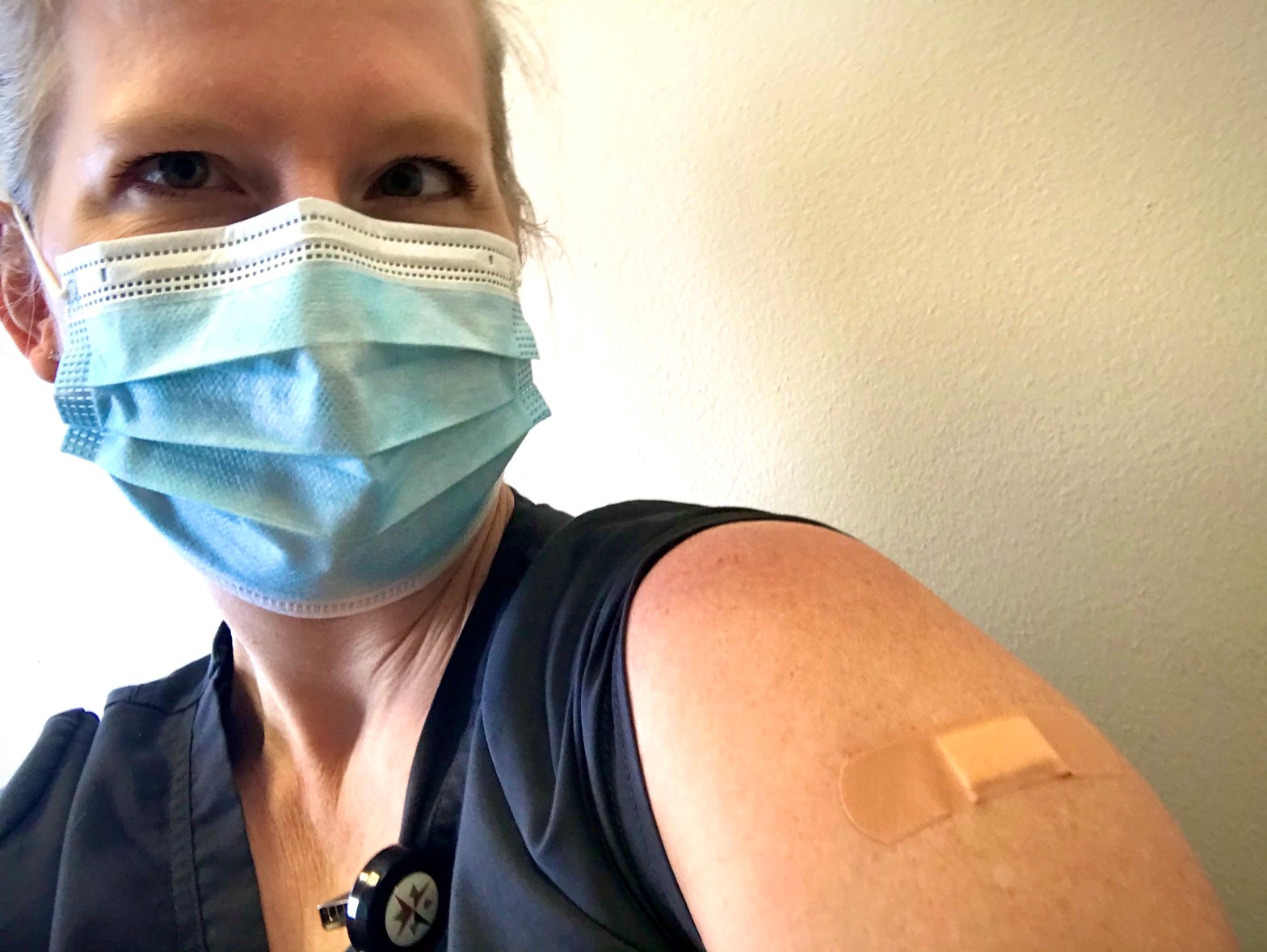
The best part about being fully vaccinated is that you can visit your loved ones and actually hug each other! I received my second dose of the Pfizer vaccine on January 4th. My parents were finally both two weeks past their second dose last week! Since my dad has medical issues, we’ve been extra careful about visiting. 

Visiting with my mom and dad today!

After working every day last week plus Easter Sunday, I was grateful for a day off. I volunteered to work Easter so that my colleagues who go to church or who have littles who look forward to the Easter Bunny could celebrate.

I texted my mom to see if they would be up for a visit today, and they were! So I made the hour drive to Tidewater. I haven’t seen them since December when my daughter and I delivered their cat we adopted for them for Christmas, which was masked, socially distanced, and brief. That visit seems like it was forever ago!

I’m happy to report that Lacey the cat has settled in nicely. You may remember that she was adopted from the Richmond Animal League, which is also where my dog, Ellie was adopted! She’s such a beautiful kitty! And, wow, does she know her food routine. She started asking for her afternoon meal an hour ahead of time!

Pretty girl, Lacey! She is a rescue from the Richmond Animal League.

It was really nice to visit with my parents, share a meal in a restaurant, and have some real discussions about life, church, etc. It’s been way too long. 

As this pandemic continues to spread, it’s imperative that as more people qualify to get vaccinated, everyone takes advantage of their opportunity. Variants don’t have as much of a chance to develop if most of the population is immune. Currently, just over 18% of the US population is fully vaccinated. Right now, we need to stay ahead of the virus. The sooner we achieve herd immunity, the sooner life will get back to normal. Don’t throw away your shot!

Have you been fully vaccinated? Has this opened some doors for you socially? Do you feel safer when out in the community? Do you support the idea of a “vaccine passport?” I’d love to hear your thoughts. As always, I hope you all are safe and healthy.

The Power of Pain

Pain. The 7th vital sign. It’s our body’s way of warning us about danger and disease. When working with my patients, it’s a question I always ask: Do you have any pain right now? As clinicians, we utilize multiple pain scales to objectively rate this subjective symptom. It’s such an important question, I’ve even learned how to ask in Spanish.

This knowledge came in handy one day when I worked a post-op unit at the hospital. There was a Spanish-speaking patient on my list, and the translator lines were down. I know enough Spanish to get by, and I was at least able to ask her how much pain she was in, and to teach her nurse how to as well. It was definitely 10/10. Her nurse was then able to give her pain meds, and later that day, that patient was getting up and walking with ease. 

Acute pain like we experience post-operatively is one thing. We typically know what caused it, and know there is a timeline for healing when this symptom will resolve. Some of us even voluntarily put ourselves through painful experiences like childbirth or running a marathon. And some of us are even addicted to post-workout pain that lets us know we really pushed ourselves in the gym. But chronic pain is a different story altogether. 

When we think of people who have chronic pain, society has painted a picture of someone who is lazy, drug seeking, and entirely unpleasant. Am I right? I hate that term. I prefer to use the phrase persistent pain. I think that’s more accurate. When I encounter patients with these issues, I have this conversation with them, and we rephrase it. This type of pain requires a skilled clinician to get to the root of the problem, not merely a bunch of band-aids to cover it up or healthcare providers to write you off as crazy simply because they haven’t found the cause. 

There is a spiritual component to pain, though, especially persistent pain. When pain begins to rule your world, it can really affect you emotionally. When you go to bed thinking about pain, wake up with it, get poor sleep because of it, and then it keeps you from doing the things you enjoy, the cumulative stress is detrimental to your quality of life. This is especially true if you seek help for managing your pain, and it seems that no one wants to take the time to listen. You can begin to feel hopeless. 

I really didn’t fully grasp the spiritual component of persistent pain until I experienced this myself. After dealing with abdominal pain and bloating for a couple of years, enduring multiple tests that cost thousands of dollars out of pocket, and seeking help from multiple doctors, I finally figured out the root of my pain after meeting a new friend. She had experienced the same exact issues. It was her IUD. The light bulb went off for me. This little device my OB-GYN had convinced me to get was causing inflammation and pain. I sought help from my doctor, and she refused to remove it. When I found a doctor who would, my pain went away almost immediately. I audibly gasped the moment it was no longer a part of my body, the relief was that immediate and noticeable. 

It took a couple more months for the pain to completely subside, but the benefit to my mental health was significant. For the first time in three years, I had hope. I had a doctor who listened and respected me. And I could finally take control of my life and my health. That moment sparked the beginning of my fitness journey that made me a marathoner. I am so grateful. I wish I had not experienced this, but it helps me relate better to my patients who live with persistent pain. 

Not everyone with persistent pain is so lucky to find such a simple solution or to so easily find a doctor who will listen. The emotional burden of the pain can become overwhelming. I have two stories about persistent pain with regard to my clinical practice as a physical therapist, and both are equally sad.

Several years ago, I evaluated a patient who had been to the ER several times for severe back pain. Reading the notes, it was clear that he was written off as a drug seeker, even when he also reported weakness and difficulty walking. Each time, he was sent home with the advice to take ibuprofen. His last visit, another symptom had developed: he had lost control of his bowel and bladder. This, my friends, is cauda equina syndrome, and is a medical emergency. This means that there is an impingement of the lower spinal nerves impairing these functions. Finally, more substantial testing was performed. He had a spinal tumor. My evaluation revealed that he had lost all sensory and motor function of his legs. I was as kind as I could be to him, but my powers were limited. I assured him he would get the help he needs. Writing his note, I cried. And I felt so angry that no one took him seriously. This man was also Black. I am certain this impacted his care initially. I still wonder what his outcome was.

I treated another patient who was injured at work. Mysteriously, they “lost the tape” that showed what happened. Workman’s comp and her employer decided she was exaggerating her symptoms, and demanded that she return to work, failing to allow her to seek proper medical care. She was only allowed to see the doctor they sent her to. Finally, she got a second opinion outside the approved work network. She had a back injury that required surgery. And since her care was delayed by months, her life was impacted significantly, as her rehab would be long and difficult. I sensed her mistrust, her fear, her anger, and I had the patience to ask and let her tell her story. I hugged her and let her cry about it. And I got counseling added to her care plan. She was also Black. I know this impacted her initial care. 

It makes me angry that certain populations are written off when they try to seek help with pain. This includes non-whites and women. Somehow, many of us get lumped in a bunch who just want opiates and attention. Sigh. This only compounds the stress experienced when dealing with persistent pain. 

However, even my own father wasn’t spared from the “pain is all in your head” narrative. When I was in grad school, he was in a freak accident where a truck pulled down a sign, falling onto his car and him. He was checked out in the ER, but they failed to determine what was causing his left shoulder pain. Even at his follow up appointment with his primary care doctor, he was told he was simply stressed out and needed to relax. A few days later, while on a mini vacation in rural North Carolina per doctor’s orders, he became very ill. The accident actually caused his spleen to rupture, and it made him septic. He spent two weeks in the ICU. Left shoulder pain is a hallmark pain referral pattern of a ruptured spleen. The ER doctor should have known. This phenomenon was even described in my orthopedic differential diagnosis textbook. 

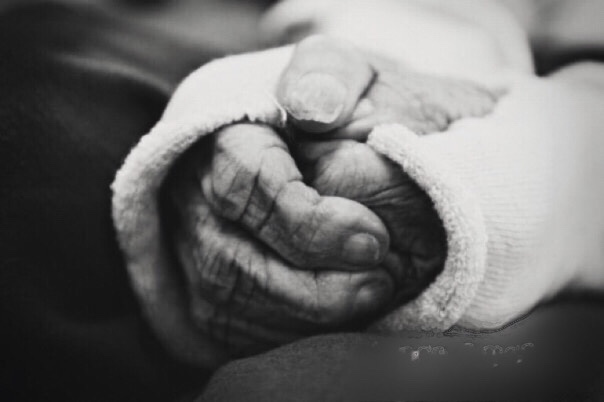
This photo is a part of a series I took for work when I practiced in a long term care facility.

Pain is also an expected consequence of aging as our joints deteriorate and muscle mass decreases. My patients with osteoarthritis are well acquainted with the companion of pain. The goal with these folks is to give them tools to manage it, and it’s a task best made multifaceted, controlled medically with topical, injected, and oral medications, and through exercise and movement to strengthen the muscles around the joints and reduce stiffness. When all else fails, there is typically a surgical solution.

But there are multiple other conditions that cause pain that have no definitive cure. For these people, they also must learn to live with the companion of pain and inflammation. They have no choice. We just help them manage as best as we can.

In other parts of my practice, I actually have the power to alleviate pain. Besides prescribing exercises and providing manual skills to help, I also have other tools to use. TENS can be very powerful in temporarily alleviating persistent post-herpetic pain and muscular pain. And I’ve found that taping can help with a multitude of issues, from helping support a flacid post-stroke shoulder that is subluxing to relieving stress to a fellow runner’s calf muscles. It brings me great joy to relieve pain.

Persistent pain is a companion no one wants. As a constant burden, it begins to overwhelm your world, and weighs heavy on one’s mental health. Compounding on this is the journey in finding a resolution to the pain, seeking the help of medical professionals who will listen. As a physical therapist, there have been many times that my skills have been able to help in this process. Having experienced this myself helps me to relate to these patients better, and it brings me much joy to alleviate pain. I certainly hope that none of you have ever had to deal with persistent pain, but if you do, don’t lose hope. Find someone who will listen and help. 

None of the experiences I mentioned occurred in my current practice setting. Have you ever experienced persistent pain? How did you manage? As always, I hope you all are safe and healthy. 

Spring is Really Here!

As I begin to write this, I’m listening to the sound of howling wind, awaiting another round of thunderstorms in Richmond, VA, our first taste of the season. Most of us were also awakened Sunday morning by thunder, lightning, and driving rain, much to the dismay of my poor dog. She doesn’t have panic attacks, but she is overly concerned and needs lots of reassurance during a storm. 

It’s officially shorts running weather in VA!

I’m normally a Sunday long run day girl, but with the predicted weather, my BFF and I chose to run Saturday instead. It was a good call! Our run Saturday was lovely, with temps in the upper 40’s to start and with excellent company, but earlier runs this week have been HOT! I really struggled with a 3 mile run in 70 degree temps with 75% humidity. If this is any indication of what my summer training will be like, I’m in trouble! 

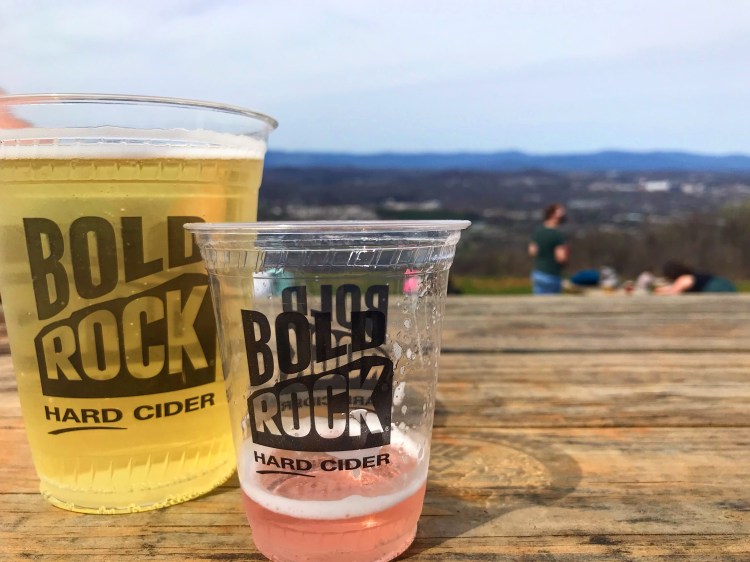
Another tradition in the warmer months? Day trips to Charlottesville. Carter Mountain sent out the email that they were open, so my girls and I decided to make the journey, enjoying the views and some cider. Bold Rock for me, non-alcoholic for them, of course! Then we headed into town, grabbing a socially distanced, semi-outdoor late lunch, and then exploring some thrift stores. 

The views are what makes Carter Mountain so great! You can also pick peaches and apples in season, and they have great food, too!

My family is making progress with immunizations. My older daughter, who works in a grocery store on her breaks from college and teaches Spanish at the elementary school level,  received her first dose of the covid-19 vaccine this weekend! My parents are officially past their immune building period after receiving both doses of the Covid vaccine. I hope to take a day trip to visit with them on my next day off! And my in-laws have completed their series as well. 

We had another beautiful day in the RVA today. The world is definitely getting greener, buds are blooming, and cars are yellow. I wanted to run today, but, alas, work and family schedules did not align. Tomorrow will be better!

The feature photo is our peach tree in bloom. Is spring beginning in earnest where you live? Are the longer days helping your mental health? Are you enjoying warmer temperatures and some outdoor activities? I’d love to hear about it! As always, I hope you all are safe and healthy.
Mass Shootings are as American as Apple Pie

Here we go again. When will enough be enough? Who has to die at the hands of yet another hysterical gunman to make the issue of gun control something that our lawmakers are actually willing to tackle? Or are we going to keep throwing our hands up, saying, “It is what it is. Can’t stop bad guys with guns. Sending thoughts and prayers.” It’s the American merry-go-round of nightmares, and no one can get off the ride. 

When returning to “normal” life in the US means 2 mass shootings in as many weeks, one of which was racially motivated and perhaps even stoked by religious “counseling” for the shooter’s sexual fetishes. The police had the nerve to excuse the Atlanta shooter’s behavior on having a “bad day.” Wow. I can’t think of a single time that I had a bad day, but felt the panacea for it was to go shoot a bunch of people with guns. It’s as if the police had more empathy for the shooter than the 8 people he murdered. Both the Atlanta and Boulder shooters had a history of mental illness but were legally allowed to buy their AR-15’s. We seriously need to rethink who is guiding our legislative bodies. 

Yes, I know. The Second Amendment. Blah, blah, blah. But our constitution was written in the time of black powder packing muskets, not AR-15’s. I don’t think our Founding Fathers envisioned such a destructive tool being unleashed on the masses so frequently, nor could they have imagined that in 2021, there would be more guns than people in the US.. The AR-15 is not a toy for the savvy gun enthusiast. It’s a weapon of mass destruction. It’s a symbol of power.

Gun enthusiasm and limits in gun control in the US are closely tied to the Christian Nationalist movement. This movement is also tied to white supremacy, limitations in reproductive rights for women, and pushing for integration of church teachings and whitewashing history into our public schools. There are some churches who even give away guns as prizes. I don’t know when gun ownership became symbolic of one’s faith in Jesus, but something needs to change. 

In Boulder, Colorado, the NRA forced a rescinding of their ban on assault rifles just days before the shooting in the grocery store that killed 10 people, allowing the shooter to purchase his AR-15 just four days prior to his rampage. 

American Flag flying on the course of the One City Marathon in Newport News, VA in 2020.

America: where you can’t go to school, the movies, church, an outdoor concert, or even the grocery store without needing to be vigilant. My kids have never known a world without shooter drills. Their first time going through one of these was traumatizing. Watching TV last night, I found it disturbing that one of the news magazines ran a segment about how to protect yourself in the grocery store in case of a shooting incident. Hiding behind shelves, peeking around corners, seeking exits when you enter a store, defending yourself with glass jars? When did this become normal? And, sadly, this is what people see when they envision America. 

Sure, sure. We also have a massive mental health crisis in this country, but no one is really addressing that, either. There’s still a stigma surrounding mental health care. Those in crisis are more likely to get “help” from a police officer and are 16 times more likely to get shot than the average encounter with police. We should send a mental healthcare professional instead. And even if you do seek help before it becomes critical, who can afford counseling that insurance doesn’t cover? There aren’t even enough available beds to help manage those in crisis. Our prison system is our back-up, and is composed of 15-20% inmates with severe mental health issues. As I mentioned earlier, both the Atlanta and Boulder shooters had documented mental health problems. Despite this fact, there were no regulations in place to stop either of them from being able to legally access a gun. 

We need sensible gun control laws. We need them now. Honestly, it’s more difficult to get a driver’s license or vote than it is to buy a gun in the US. Contact your state lawmakers and tell them you want change. Don’t know how to reach them? Find out here.

Certainly the fear of gun violence is the fringe worry of many Americans, including school age children. The anxiety this can cause can really take a toll on our mental health and overall wellness. Do you think it’s time for sensible gun control laws in America? Do you think we need to improve access to mental health services? As always, I hope you all are safe and healthy. 

Vegan Dilly Potato Salad

With spring beginning to come into full swing and vaccinations increasing,  I’m dreaming of the possibility of outdoor gatherings again. Whenever I think about potluck meals, I think of potato salad. 

If you are a fan of German potato salad, you will love this vinegar dressing based version.  I’ve never met a potato I didn’t like, but I especially enjoy a great potato salad. This one is a bit off tradition. It seems like a lot of vinegar, but it’s definitely more mellow than you think it might be! So, without further ado, I give you Dilly Potato Salad!

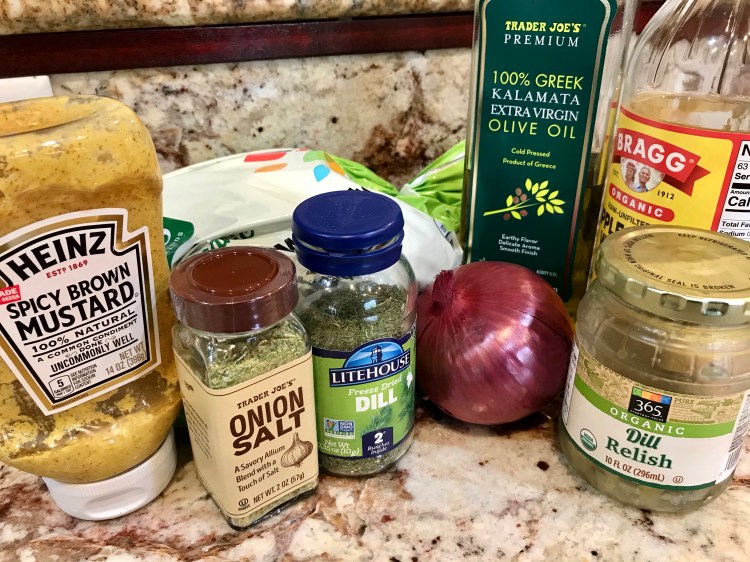
Basic ingredients for this recipe. I only used about 1/2 of this onion.

Ingredients:

  • 3# bag potatoes (Russet, yellow, or red all work well)
  • 1 Small/medium red onion, or ½ large
  • ¼ cup dill relish
  • 1 T dried dill weed (I like Litehouse brand)
  • ¾ cup apple cider vinegar (I like Bragg’s)
  • ¼ cup olive oil, or 2 T olive oil and 1 T vegan mayo
  • 1 T whole grain or spicy mustard
  • 1 tsp Trader Joe’s onion salt
  • Salt and pepper to taste

Directions:

  1. Wash and peel potatoes. Note that if you are using yellow or red potatoes, these do not have to be peeled, especially if they are small. Just remove obvious eyes and bad spots. 
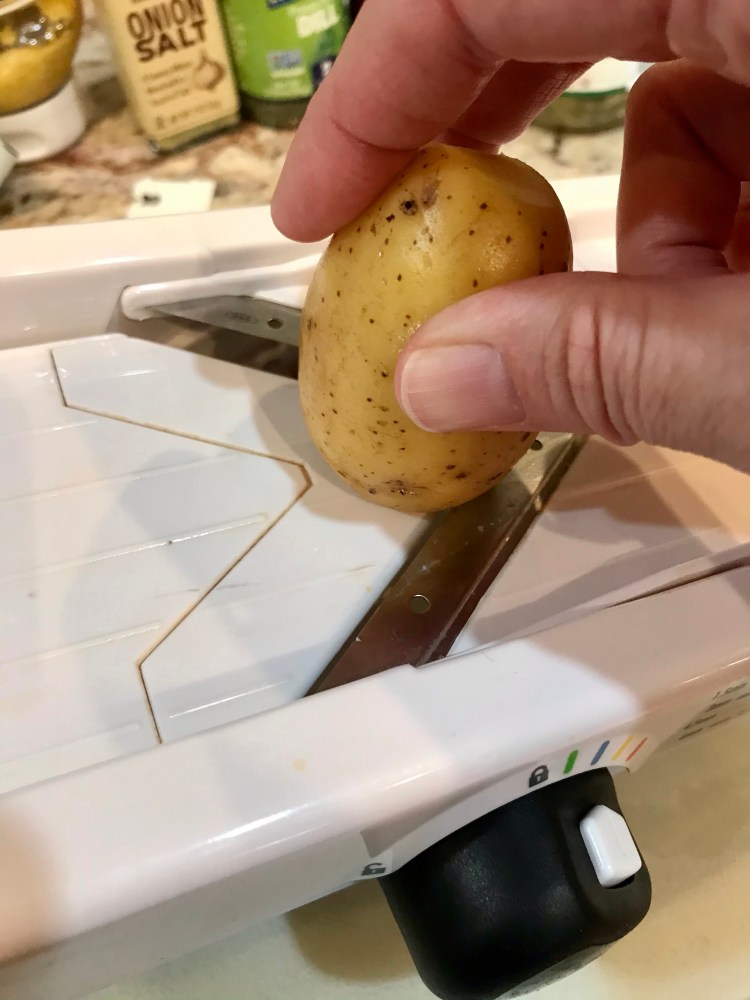
  2. Using a mandolin, slice into ¼ inch slices, or slice by hand. I typically slice with the mandolin until about ⅔ of the potato is sliced, then finish by hand to reduce the risk of slicing my fingers. 
  3. In a large soup pot, boil potatoes in enough water to cover potatoes. Salt water generously. Boil until potatoes are soft and break easily with a fork and when stirred, about 15 to 20 minutes.
  4. While potatoes are cooking, prepare the red onion. Leaving the root end intact, cut off the other end and peel the onion. Cut the onion into fourths, almost to the root. Use the mandolin to slice the red onion into 1/16 inch slices, or slice by hand.
  5. Once the potatoes are cooked, remove from heat, and drain. Return the potatoes to the pot and let sit.
  6. Make the dressing. Combine the vinegar, olive oil, mayo if using, dill weed, mustard, onion salt, and salt and pepper. Pour over the potatoes.
  7. Add the onions and dill relish to the potatoes.
  8. Mix well and allow to sit, lid on pot, until cool. Potatoes will break apart and absorb the dressing. Onions will “pickle” in the dressing alongside the warm potatoes. Refrigerate and enjoy!
Slicing the potatoes.
How to cut the onion for slicing on the mandolin.
The mandolin makes quick work of slicing the onions!
Bringing the potatoes to a boil.
Pouring the dressing over the hot potatoes and the sliced onions.
Finished potato salad!

If you try this salad, post about it on Instagram and tag me @annecreates. I’d love to hear about it! As always, I hope you all are safe and healthy.