The Power of Food

Our food choices are certainly a big part of how we identify as humans. Food can reflect our culture, our religion, and even our political leanings. Food can prove elusive when it’s not affordable or accessible. Food, or lack thereof, can cause disease. In extreme cases of food allergies, food can cause death. Beliefs about food can divide households. But food is also the backdrop for celebrations. And food can bring comfort. Preparing food can be a creative outlet. And food can be love.

Our relationship with food begins with the choices of our parents. One of the best examples I can think of is the debate about sweet tea or unsweet tea. If you are raised in the south in the US, you know tea is typically so sweet, it might as well be syrup. Well, my parents are both from the deep south, and my brother and I were raised drinking unsweet tea! What a scandal. We were certainly outliers among our friends in Virginia. But I’m grateful that my parents made this choice for me. My tastebuds were trained for less sugar.

A choice that wasn’t decided by my parents is my journey toward going vegan. It began as an 18 year old when I decided to go pescatarian. In 1993, this wasn’t as easy as you would think, especially when you relied on your college’s dining hall for sustenance. I haven’t had red meat or pork since. Later on in life, I went full vegetarian, finally transitioning to vegan when I discovered that dairy was a source of inflammation for me, contributing to my asthma symptoms. I haven’t had bronchitis since going vegan, and I used to get it 2-3 times a year. 

But having the distinction of “vegan” conjures different emotions for people. I used to work in an office where half of my colleagues were keto. We would have breakfast team meetings where our boss would buy huge platters of eggs, bacon, and sausage to share. If you’ve never been in close proximity to someone who is in ketosis, consider yourself blessed. The perfume of exuding ketones is less than pleasant. In this office, I was Anne, the vegan. It was definitely more of an eyeroll, almost a slur, with the inflection of the comment. I was definitely the weirdo of the office, and as you may have guessed, I didn’t stay long. Thus, the name of my blog was born. I flipped the derogatory comment into something positive. 

My mom’s potato soup, “veganized.”

I view fundamental food choices like I do religion. I choose to live vegan, which encompasses so much more than just food, but I try not to preach. I will certainly share my journey, why I choose to live this way, and the benefits this lifestyle has given me, but I respect the choices of others, even if they don’t respect mine. Life as a woman has trained me well to walk that fine line of trying to educate, but not offend. No one else in my house is vegan, but I’m pleased that my kids and my husband will taste many of the vegan meals I make, and I’ve even converted my husband to almond milk, which I never thought would happen! He needs to keep his paws off my Hippeas, though! 

Eating the “right” food can mean different things to different people, and opinions are so varied. Discussions can become quite contentious and divisive. What’s even more confusing is that there doesn’t seem to be any clear research asserting what these “right” foods are. When reading research, don’t overlook the fine print: who funded the study? This often guides the take on good vs. bad. 

Depending on our relationship with food, we can also feel guilty because of our “bad” food choices. Too many sweets? Gluttony. Too many fried foods? Fattening. And we can feel ashamed because we dared to indulge. I operate under the assumption that we all deserve a treat every now and then. However, we can sometimes develop unhealthy relationships with food, leading to habits that develop into eating disorders. “Bad” food choices are often also dictated by convenience. Why bother cooking at home when you can simply go through a drive-thru? But sometimes, we are forced to make “bad” food choices simply because, if you can’t afford “good” food, you choose what you have the means for, since cheap calories equals full bellies. 

Early last year, pre-pandemic, I was in line to buy groceries at Wal-Mart. There was a woman in front of me with two small children. She had carefully calculated her purchases, and she pulled out her EBT card to pay. The system rejected her choice of a small rotisserie chicken, something she had apparently been able to purchase before. New rules, apparently, deemed this choice a “luxury.” I bought it for her. It was a $5 chicken. I can’t imagine what she was feeling. Who in the government declared a pre-cooked chicken a luxury? She was grateful. For me, it was the cost of a fancy coffee. For this young mom? It was multiple meals. 

As much as food, or lack thereof, can divide us or make us feel shame, it can also unite us. It is the glue of celebrations. There’s always a party after a major life event, right? Cake for birthdays. Receptions for weddings, bar mitzvahs, and even funerals. We can learn about different cultures just by tasting the food associated with it. And for me, spotting another person in the grocery with vegan things? Always a quiet celebration. 

Does your family have a celebratory dinner or dessert that’s a favorite? Growing up, that dish was chicken and dumplings. My mom makes the best. And although I don’t eat these anymore, I still remember my mom boiling the chicken all day, mixing and rolling out the dough, and putting the dish together. It was a long process that she did with much love. This became our holiday meal instead of turkey and trimmings for Thanksgiving and Christmas. My mom also makes the best potato soup. It was comfort in a bowl when we were sick. A favorite from my husband’s family? My mother in law makes a pound cake that my husband loves. There are pictures of him as a toddler, sitting on the kitchen floor with a giant bowl of batter, eating it happily. 

So, getting back to another point: food is love. It is, quite simply, one of my love languages. Is it one of yours, too?  I’ve always enjoyed cooking and baking. As a teenager, if I didn’t have somewhere to go on a weekend night, I baked. Now as a married adult, I am the cook. We typically only eat in a restaurant once or twice a week. I also tend to be the cook on big family vacations. I love to make cakes from scratch, my mom’s potato soup, and parts of celebratory meals. I enjoy that role so much, especially since there’s always someone else to clean the dishes! I also enjoy gardening, and that is its own special labor of love in growing your own food, something that I became reacquainted with during the pandemic.
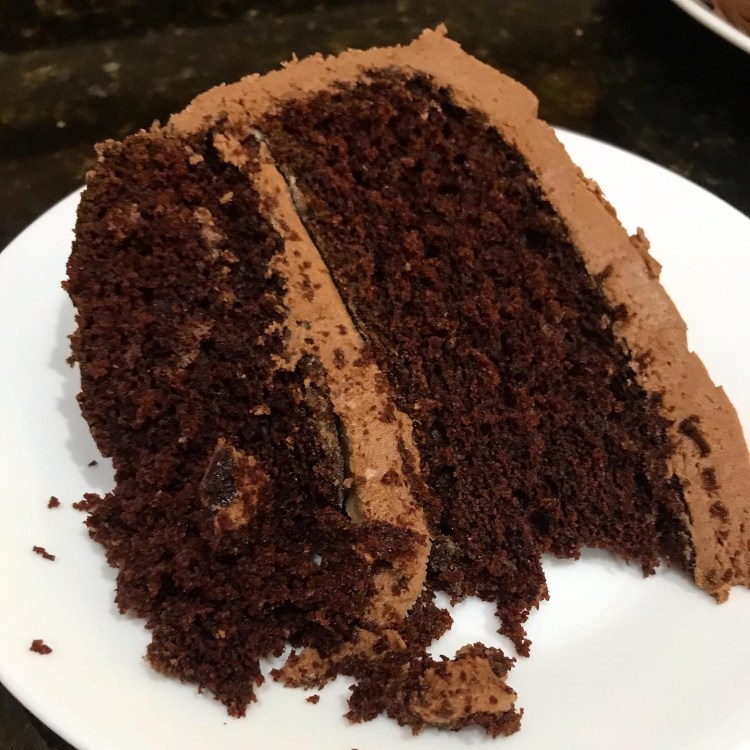
My current favorite cake to bake: chocolate cake with chocolate frosting. All vegan, of course!

Clearly, food choices, at its most fundamental level, define us spiritually. Even if we can’t eat certain foods because of allergies, that still defines who we are in some way. Our relationship with food is a part of who we are as humans. Our choices can be beneficial or harmful. They can divide or unite us. They can reflect our culture. They can reflect our beliefs. They can bring us health or illness. They can be love. That’s the power of food. 

How does food help define you as a person? Does your family have special celebratory meals that bring everyone together? Do you passionately follow a unique diet? Do you grow your own food? I’d love to hear about it! As always, I hope you all are safe and healthy. 

Race Recap: The Sports Backers Half Marathon

Yesterday, I ran the Sports Backers Half Marathon. We had beautiful weather! My best friend Patty convinced me to sign up a while ago, and, although our winter training did have a few hiccups, we managed to comfortably finish the half in about 3 hours. My PR is 2:21, but I haven’t been training nearly that fast lately. It is what it is. So, the goal was to stick together and simply have fun.

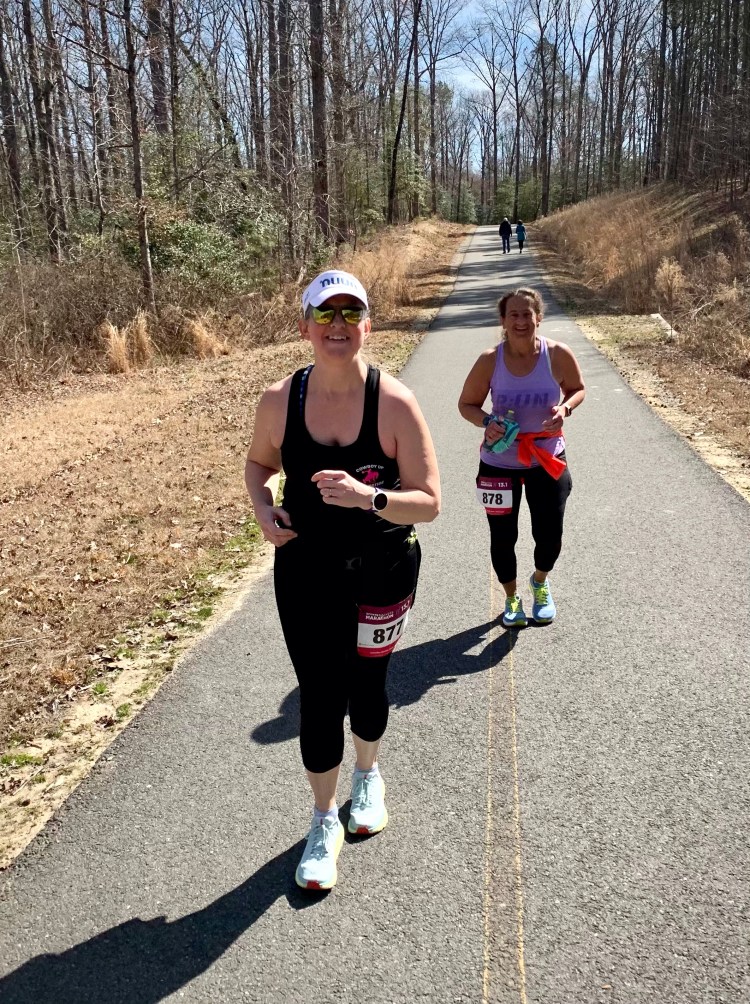
Patty and I running the course! Photo courtesy of Steve Yancey.

If you aren’t familiar with Sports Backers, they are a large non-profit in Richmond that puts on stellar races, most notably the Richmond Marathon in November and the Monument 10k in the spring. They know how to organize a race! The profits from events like these get funneled into community programs like Kids Run RVA and the Fitness Warriors to support their mission of promoting active and healthy lifestyles in the Richmond area. 

With the giant bike at Four Mile Park along the Virginia Capital Trail. Photo courtesy of Steve Yancey.

This race is new this year, and there was a marathon course and 5k as well. It roughly followed the course that Sports Backers used from Dorey Park along the Virginia Capital Trail last year for the Richmond Marathon races, as the format needed to change due to the pandemic. For this race, they kept the window when you could run to 3 days instead of a couple of weeks. They also tweaked the course a bit, which Patty and I really liked. There was an out and back that took you past Dorey Park that was tacked onto the end of last year’s race, but they made that part first this year. Mentally, that was better for me! They also had Nunn on the course!

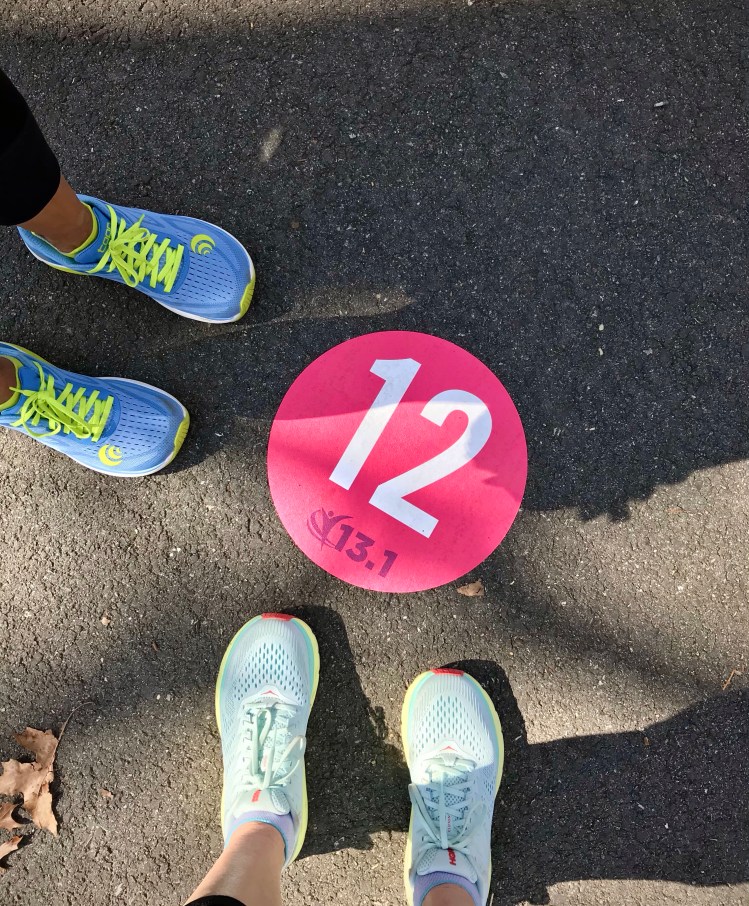
Mile 12! The end was near…

As far as the weather is concerned, we couldn’t have asked for better. Yes, it was chilly at the start in the upper 30’s, but it warmed up pretty quickly, and was well into the 50’s at the end of our run. It was sunny, but with a nice, gentle breeze, and so whenever you started to feel hot, that breeze would come along and cool you down. 

Crossing the finish line! Photo courtesy of Steve Yancey.

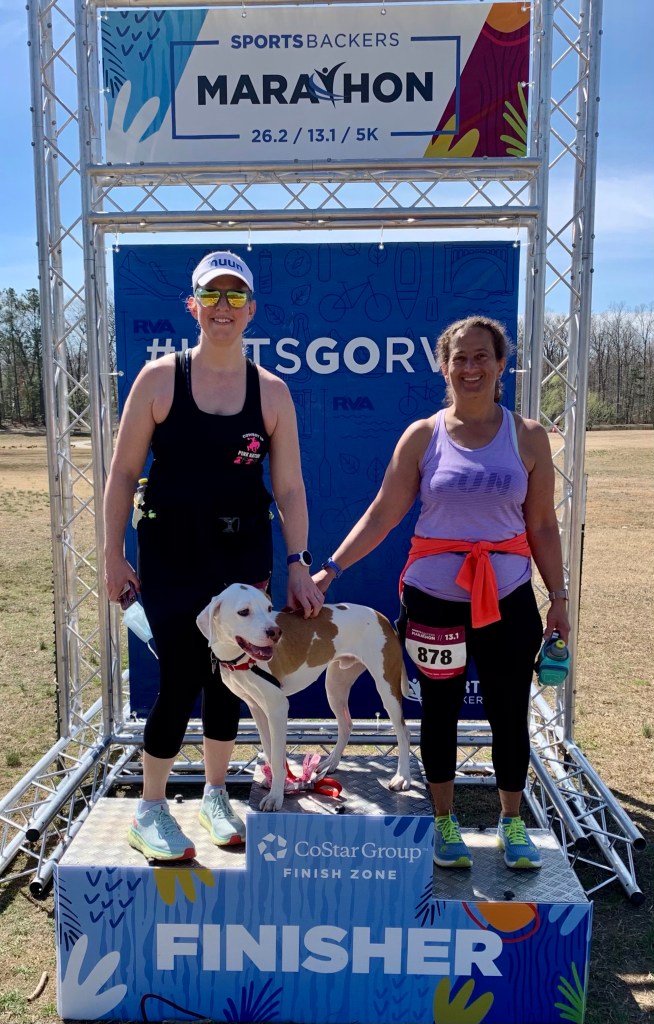
Patty’s partner, Steve, joined us for the last 3ish miles of our run with their dog, Finn! Finn was adept at warning us about all the squirrels and enjoyed leading his pack! Steve also took some great pictures for us.

With Finn at the finish! Photo courtesy of Steve Yancey.

Overall, I think Sports Backers has made the best of the pandemic, creating fun virtual races, endurance challenges with teams, and adapting their live race formats to make some of these possible. Even though we didn’t have the big crowds to encourage us on the course, we did see lots of friends on our run! It was so nice to actually run a real race!

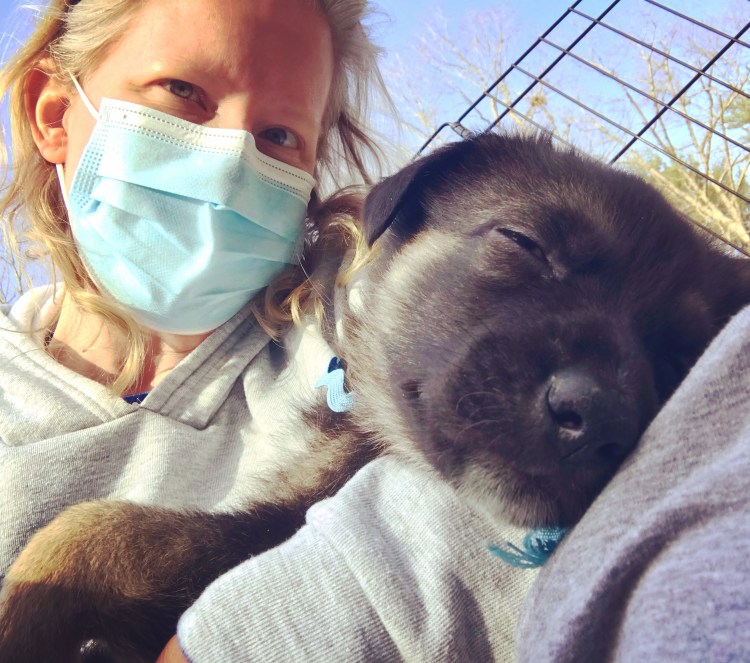
Later yesterday afternoon, I got to visit with my neighbor’s German Shepherd puppies! Mama had a litter of 11! Can you imagine? Anyway, they were absolutely precious! If you want to follow their adventures and soak up some adorableness, check out my neighbor’s blog, Shepherd Sight. I promise her content will lift your spirits!

Puppy snuggles are the best!

Have you run any virtual or modified races during the pandemic? I’d love to hear about it! As always, I hope you all are safe and healthy.
Is it spring yet? Winter running update…

Yesterday’s run was warm enough to wear shorts and a singlet! 70 degrees at noon. It was beautiful, but I got hot! And the bugs are already out. It’s way too early to be shooing flies. I’m sure we will have a couple more winter revivals before Virginia decides it’s actually spring. She’s fickle like that.

First official run in shorts this year. It was 70 degrees for this run. Second run in my new Hokas!

I can’t recall a winter training season with as many snow runs as I’ve done this year! I kind of enjoy running in the snow, although these are done from home, and there was way more traffic than I anticipated for these runs. But running in these conditions automatically makes you way more badass than running in fair weather!

Fleece lined tights and trail shoes for one of my snow runs last month.

This winter has been super weird just because there are no winter running groups going because of the pandemic. I will run with a small group of a few fellow coaches and friends, and sometimes with my best friend, but for the most part, my runs have been solo. It’s been a bit lonely. That’s saying a lot for an introvert!

My typical maintenance plan for running is 3 runs per week with cross training. I will run 3, 3, and 6 miles, keeping this up until it’s time to ramp up mileage for a race. Since 2014, I’ve run at least one spring half and a fall full marathon every year. This year, I’m running two spring half marathons, one of which is this weekend.

Changes to the plan this year included a running streak from Thanksgiving to New Year’s Day. I was really hoping to incorporate more cross training this “off” season, but with Covid spiking in December and January, I have avoided the gym, even though I’m now fully vaccinated. The shift to focus more on running made since then. But despite staying active all through the past year, I’ve managed to put on way too much weight. None of my clothes fit! Can anyone else relate?

First day of my run streak last year on Thanksgiving Day. We were vacationing on the Outer Banks of NC.

The other event that kept me focused on running just wrapped up: the Desert Storm 218 Miler in the Marine Corps Marathon series of events. With my friends Patty and Denice, we ran this mileage as a team from the middle of January to the end of February. It definitely kept me motivated, and I ended up doing 2, 10 mile runs on successive weekends to help add to our total, as well as to prepare for this half marathon.

I had a decent 8 mile run this past Sunday, and I’m as ready as I’m going to be for the Sports Backers Half Marathon! This follows a similar format to their fall modified races, running along the Capital Trail from Dorey Park in Henrico County. The course is open from Friday to Sunday, and since I’m working Saturday, I’m running Sunday. Thanks to Christmas money, I have brand new Hokas that I have now broken in for my spring races! The weather forecast looks good, with clear skies and low 50’s. Wish me luck! I’ll have a race recap next week.

If you are a runner, how has your training been going over the winter? Are you preparing for a race, even if it’s a virtual one? Have you been going to the gym? Have you had any sneak peeks at spring weather yet? I’d love to hear about it! As always, I hope you all are safe and healthy.

Will Eating Tofu Make Men Grow Boobs? And Other Mysteries of Soy

Tofu isn’t sexy, manly, or exciting, apparently. My husband avoids soy products like the plague, fearing the effects of the estrogens in tofu and soymilk. It doesn’t matter how much evidence I provide to the contrary. The old myths stick, even though soy products are actually in many of the processed foods we eat. However, those of us who consume it know that organic tofu is an inexpensive, high quality source of protein, with a complete amino acid profile. But to new vegans, cooking with it can be a bit intimidating. 

I’m pretty sure that to those who are die-hard carnivores, the thought of going vegan means sitting around eating giant bowls of tasteless tofu for every meal. And even my husband subscribes to the disproven notion that increased soy consumption will lead to lower testosterone levels and feminization of the male body due to the phytoestrogens. I get it. Once that seed of doubt of safety is planted, it’s really hard to deprogram. But seriously, if eating tofu made you grow larger breasts, I think soy consumption would be even higher. Forget breast augmentation surgery. Just eat tofu! Ha.

So what about the estrogens in soy? Soy contains phytoestrogens. These differ from the estrogen found in our own bodies, but are they good for you? Many studies say they are, offering anti-cancer properties, improving cardiovascular health, and quelling menopausal symptoms. Phytoestrogen research is still ongoing.

If you stick to a traditional omnivore diet with heavy meat and dairy consumption, does this mean that you won’t be ingesting hormones? No, it does not. In fact, taking in dairy, especially full fat products, can significantly increase estrogen and progesterone levels and decrease testosterone, affecting male fertility especially. This has to do with modern dairy farming practices in the US, where dairy cows are milked while pregnant, significantly increasing hormone levels in dairy products overall. Since sex hormones are fat soluble, they are significantly more prevalent in full fat dairy products. Ingestion of these hormones in dairy milk are also correlated with higher incidences of breast, ovarian, and prostate cancers. 

It’s really important, however, when purchasing tofu to look for organic products. Most soy grown in the US is genetically modified, meaning Round-Up ready. Glyphosate, the main ingredient in this herbicide, is a known carcinogen. It’s really best to stay away from non-organic soy products. 

So now we have established that organic tofu is a safe, nutritious source of protein, let’s talk about how to utilize it! As a new vegan, I was really afraid of tofu. But I discovered how to prepare it by eating at restaurants. I figured great places to eat would know how to prepare tofu well, which they did, and then I would try to recreate the meals at home. My local Thai and Vietnamese restaurants make wonderful vegan dishes with tofu, and there are a couple of local places for brunch that make a great tofu scramble. 

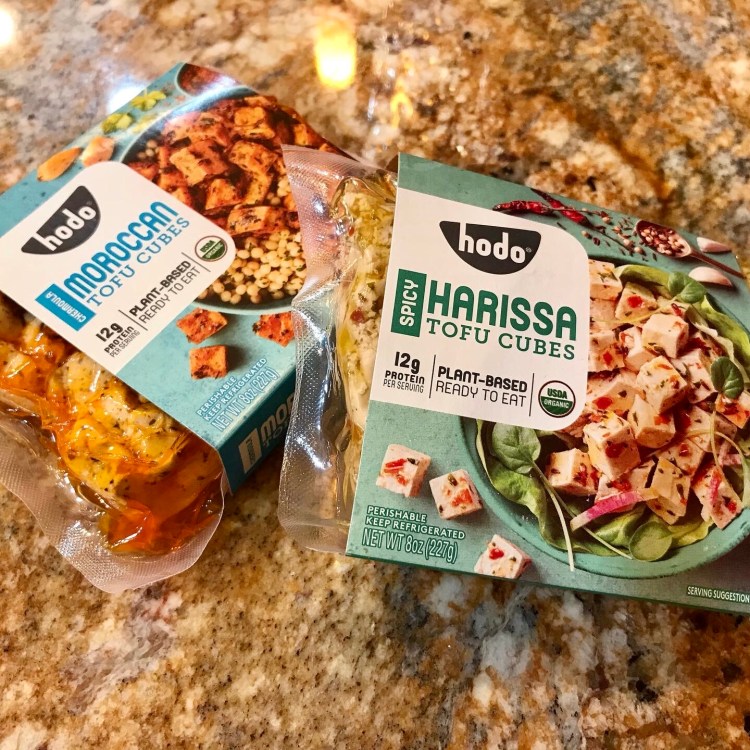
Seasoned tofu from Hodo.

I began to purchase prepped tofu from the grocery store. Hodo makes great seasoned tofu as well as Trader Joe’s. Using these in meals helped me build confidence in prepping this otherwise bland item at home. I began to look at tofu more like a sponge to absorb whatever flavors I liked, pressing as much water out of the block as I can beforehand, cutting it into blocks or strips, and marinating before cooking. 

One of my favorite twin packs of tofu from Trader Joe’s.

It’s also helpful as the only vegan in my house to buy the twin packs of tofu. That way, I’m not prepping a large quantity of it at a time. I often make tofu scrambles for breakfast and another scramble either seasoned like chorizo or with Asian flavors like soy sauce, ginger, and garlic. It’s super easy. 

A recent batch of breakfast tofu scramble.

Here’s a simple recipe for Breakfast Tofu Scramble for Two:

Ingredients:

  • ½ block extra firm tofu (or one side of a twin pack), pressing out water as desired.
  • A variety of chopped vegetables (I like onions, peppers, tomatoes, and frozen prepped shredded hash browns, about 2 cups of veggies overall. Use whatever you have!)
  • ½ tsp. Turmeric
  • 1 T olive oil
  • Salt and pepper to taste

Directions:

  • In a non-stick skillet over medium heat, warm the oil, then add the vegetables, sauteeing until lightly browned. 
  • Add the tofu, crumbling into small pieces.
  • Add the turmeric, salt, and pepper.
  • Once tofu is of uniform color and warm, your breakfast is ready!
  • Leftovers keep for a few days in the refrigerator. 

Hints:

  • If you like spice, try adding smoked paprika and red pepper flakes.
  • If you want to add a bit of brightness to the dish, the Trader Joe’s Cuban style Citrusy Garlic seasoning blend is wonderful with tofu scramble. 

Tofu can be cooked multiple ways, but I found scrambling to be the easiest and least intimidating method. Using Asian flavors in a scramble makes a great base for air fried spring rolls, lettuce wraps, and addition to fried rice. Using chorizo spices makes a great protein for burrito bowl nights at my house. You can also pan fry strips and air fry strips and cubes, just keep in mind that tofu cooks quickly and can become almost too chewy in the air fryer if you aren’t paying attention!

Asian style tofu scramble made with soy sauce, Trader Joe’s umami seasoning, garlic and ginger frozen cubes, over rice with broccoli and the Chinese brown sauce from the Forks over Knives cookbook.

Some great sources for tofu recipes include:

I hope this inspires you to try preparing tofu based recipes at home! Or, at least, feel inspired to try a tofu dish next time you dine in or order takeout from a restaurant!

Over the years, I’ve cultivated a comfort level with tofu that I never expected. It’s certainly not my only source of protein, but it’s definitely become a more significant part of my diet the longer that I’ve vegan. I haven’t reached expert level in its preparation, but it’s not so mysterious anymore!

Do you like tofu? Do you prepare it at home? If so, what are some of your favorite recipes? I’d love to hear about it! As always, I hope you all are safe and healthy. 
The Power of Gait

I evaluated a new patient over the weekend. She had a stroke, and her notes from acute care said she required maximum assistance of two people to get out of bed and into a wheelchair, and that she had limited use of her left side. I was pleasantly surprised that she appeared in person so much better than she did on paper. I could help her to the chair by myself. Her goal? As is so common with all of my patients: To walk again.

Throughout my practice of physical therapy, I’ve discovered how spiritual the most human act of walking can be. It’s something we take for granted, really. I also feel bad for my fellow therapists in other disciplines, as the PT’s are often the stars of the whole rehab show in the eyes of patients, at least initially. I see it as part of my job to sell the importance of all aspects of rehab. But the first goal for most patients? Everyone wants to walk. 

From infancy, we long await the development of this crucial milestone, usually at about one year, give or take a month or two. As parents, we are so proud of our babies in learning how to walk on two feet. It’s something to celebrate, indeed! 

My younger daughter taking her actual first steps while we were on vacation on the Outer Banks. She was 10 months old.

Likewise, as we age, loss of mobility, especially walking, most likely means the loss of your independence. It’s the fear that plagues every adult patient, from post orthopedic surgery to weakness from prolonged hospitalization to having a stroke. It is also a fear of caregivers, as the burden of care is typically significant for someone who cannot ambulate, as are the logistics of getting out of the home for appointments, etc. 

Having a stroke is especially impactful on someone’s life, and it’s one event most associated with long term deficits. It’s also really challenging for those who have suffered a stroke and are still cognitively intact. If I find my patient has adequate trunk control to sit up on the edge of the bed with only minor steadying or better, we walk, even if they have limited use of one side of their body, and even if it’s just a few steps. 

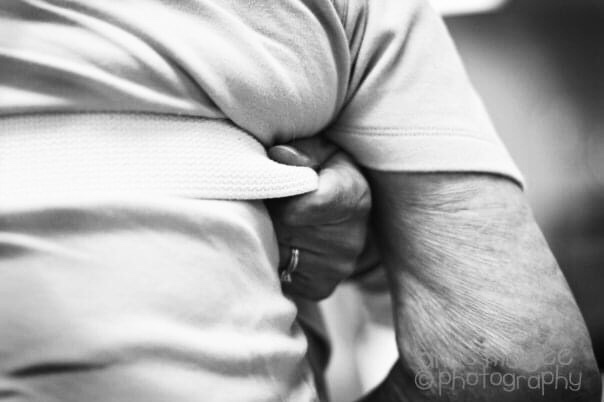
Using a gait belt to help lift and stabilize a patient to stand.

I’ve got lots of skills in my bag of tricks to make this happen. We may start in the hall using the guard rail for support if an arm has limited mobility, too. We may have to wrap the weak foot with an ace wrap to hold the toes up. I may need to move the weak leg for them, hold it, and keep it from buckling. And I definitely have a second person to help. But we walk. And we celebrate those first steps!

Of course, these are “old school” tricks. Nowadays, there are body weight support systems with harnesses that prevent falls and functional electrical stimulation to help re-educate the body in how to ambulate. But I always begin with tried and true, low tech methods. 

My patient over the weekend did walk with me. We did use the guard rail. But she could advance and stabilize her affected leg fairly well, only requiring overall steadying, with a second person to follow with a wheelchair to sit when she fatigued. She walked ten feet. And we indeed celebrated like it was a mile!

Certainly the victory of the first few steps is just as sweet for those who have to work harder to get there. I was so inspired by a recent patient who had been in the ICU for quite some time before coming to rehab. He struggled to even stand in his first week. But by the end of the next, he was walking short distances with a walker. So awesome! 

Patients post surgery are a bit different. I love getting patients up for the first time after back surgery. I usually find the same sequence of events. Patients are cautious at first, taking care to not walk too fast. They are taking inventory of what works, and what doesn’t. I often ask what they are feeling. It’s a great result when they admit that the pain they felt prior to surgery is gone. All they feel is the pain from the incision. This they know will resolve. The other, they weren’t sure. It’s a great sense of relief for them. Once they test out those sea legs, they usually progress well. 

Teaching a patient to use assistive devices like this single point cane is just one of the skills we use to help people gain independence with walking.

Those with spinal cord injuries have to adjust to a whole new mindset. Can you imagine losing your ability to walk as a teenager? My colleagues and I discussed this last week. So many of us have worked with patients who have become paralyzed from gunshot wounds, car accidents, falls… we seem so invincible, especially as young people, until we’re not. But can you imagine losing your ability to walk because someone shot you over a pair of shoes? The grief. The what-ifs. Overwhelming. This is when you truly want a magic wand to fix it all. 

I recently worked with a patient who is about 20 years post injury. He’s been in a wheelchair since he was 17. He’s had the chance to fully process his life changes. He admitted how angry he was after his injury. He loved rehab the first go round, but once he got home, reality settled in. He said it was his toddler son who brought him out of his funk. But he chose to participate in life, as much of a struggle as he faces. He admitted that he was surprised by how challenging it was to go through rehab again so many years later with a much older body. But he did progress well enough to return home. 

A couple of years ago, I worked with a patient who was about 30 years post injury. He had fallen down several stories to the ground at a construction job. He knew immediately after falling that he was paralyzed. He seemed so well adjusted. But after so many years in a manual chair, his rotator cuffs were spent. It was time for a power chair. I specifically asked him about how he was handling the change emotionally, and he offered no indication that he was struggling. I recommended counseling from our team anyway. I learned that later that year, he died by suicide. I was heartbroken. I think for him, losing the manual chair symbolized his loss of independence. 

My own grandfather became a quadraplegic after surgery. He underwent a laminectomy to correct spinal stenosis back in 1980 when we weren’t doing hundreds of these procedures every day in the US like we do now. For multiple reasons, the surgery failed. He went from walking with a cane to being dependent on a wheelchair for mobility. He managed the best he could. I wasn’t old enough to grasp how emotional this life change was for him. But I do recall lots of lightbulb moments in PT school when we were learning about spinal cord injuries, relating what I remembered about my grandfather’s experiences with life after his injury.

Some of these patients who have suffered spinal cord injuries have been able to walk with the help of exoskeletons. Is this practical? Not really. But is it awesome? Indeed! During the 2016 Marine Corps Marathon, an injured soldier completed the last 10k of the marathon course, starting when the marathoners did, wearing an exoskeleton and with a whole team of support with him. I passed him at about mile 25. Keep in mind that I’m a 5+ hour marathoner. That’s how slow a process it is. But to watch someone use this device in the clinic for the first time is a privilege. The sheer joy of standing upright and walking is palpable, and it will move you to tears.

Why go through so much effort to walk if it’s so challenging? Among many physical benefits, there are mental benefits of feeling proud of taking those first steps. They can call their loved ones and say, “I walked today!” It gives hope. It calms anxiety. It renews faith in yourself. For those with spinal cord injuries, the use of exoskeletons allow for continued mobility in the hopes that stem cell research will eventually be able to restore what was once lost, making sure the body is ready by maintaining the benefits of weight bearing and maintaining range of motion, simply by bypassing the neurological injury. And it sets the path in motion for retraining the body to do this most human activity of walking. 

Just as helping someone return to walking if possible is important, it’s equally important to help my patients who may never be able to return to ambulating adjust to a new normal. We focus on gaining independence with wheelchair mobility and transferring into and out of the chair. But even in long term care settings, those residents who could take a few steps with help had a restorative program to do so. We would train the CNA’s providing this service to help maintain this skill. It was as much to help the residents physically as it was mentally. 

I’m privileged to possess the knowledge and skills to help my patients reclaim their ability to walk when they can’t. It brings me great joy. It’s part science, part art, and part cheerleading. I remember my patients who can’t walk when I run. I never take for granted that I can do so. I don’t have to run. I GET to run. Let’s not take for granted our ability to walk on two feet, a most human trait, indeed. 

All photos featured here were taken as part of a special project when I worked for a continuing care facility with the exception of the photo of my daughter, obviously! These are still on display there.

This is my second post in my Power Of series, focusing on spirituality. Do you feel like walking is a part of what it means to be human? I sincerely believe, after all of my years of practice as a physical therapist, that the ability to walk affects us on a spiritual level. Have you been affected by loss of mobility or by a family member or loved one who has? I’d love to hear about your experiences. As always, I hope you all are safe and healthy.

Grocery Tour Series for Vegans: Food Lion

In Virginia at least, the two grocery stores you can find in rural areas are usually Walmart and Food Lion. My town of Ashland is no exception. Although just outside the city of Richmond, the town itself can only claim these two as real groceries. Sure, we’ve got a great farmer’s market in the summer and the independent Cross Brothers grocery, but for everyday items, you need a big grocery store.

I’ll have to admit: I’m kind of a grocery snob. I don’t often shop at Food Lion in Richmond because we have so many other great choices in close proximity to my places of work, or have such unique items that it’s worth the drive. 

Years ago, Food Lion was the only choice for grocery shopping when we stayed on the Outer Banks, and, oh, how I was not pleased with that. But we made due, often bringing multiple non-perishable items from home. Fortunately, the choices for grocery shopping on the OBX have expanded tremendously in recent years. 

Speaking of choices, we are so very fortunate in the Richmond area to have the mecca of all grocery stores. We seem to have more choices in the metro area than anywhere else in the country! I tend to go into Henrico County for most of my grocery shopping, but I thought it would be a good idea to visit my neighborhood Food Lion in Ashland to see what they have, and also to compare the rural store to their more urban locations. 

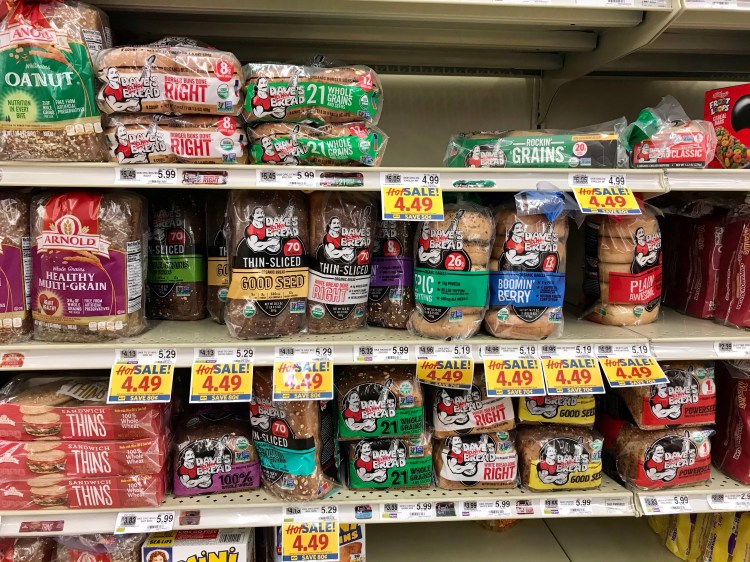
My first stop was to a Food Lion location on the busiest road in west Richmond, Broad Street. I was underwhelmed. They do carry tofu, a limited selection of Vivo Life cheese, a few Gardein items, and Daiya cheese. But I was surprised by the lack of some of what I consider very basic vegan items, like organic sugar and at least one type of vegan-friendly chocolate chips (usually if you find these in the gluten-free sections, they are vegan). But I didn’t find either. I did, however, find Just Egg, Helleman’s vegan mayo, Dave’s Killer Bread, and Silk yogurt. Those were pleasant surprises. 

Dave’s Killer Bread. Great prices!

I was also caught off guard by the associates stocking the floor. As I was taking pictures and making notes on my phone, one of them asked me what I was looking for. I revealed that I was a blogger, etc., and he was eager to tell me about all of the vegan items they had in store. He even sent a manager my way to show me around. It was a nice gesture. 

The produce section at my Ashland store.

I was so disappointed overall that I almost didn’t visit my Ashland store. But wanting to give the benefit of the doubt, I did go. And you know what? The small, college town of Ashland’s Food Lion delivered more than its more urban counterpart. I was pleasantly surprised. Here’s what they had to offer:

  • The entire Vivo Life cheese line. 
  • Multiple tofu items, Lightlife, Field Roast, Good Foods, and Tofurky products
The surprising selection of vegan brands in the produce section.
  • Daiya and Annie’s vegan mac and cheese.
Vegan mac!
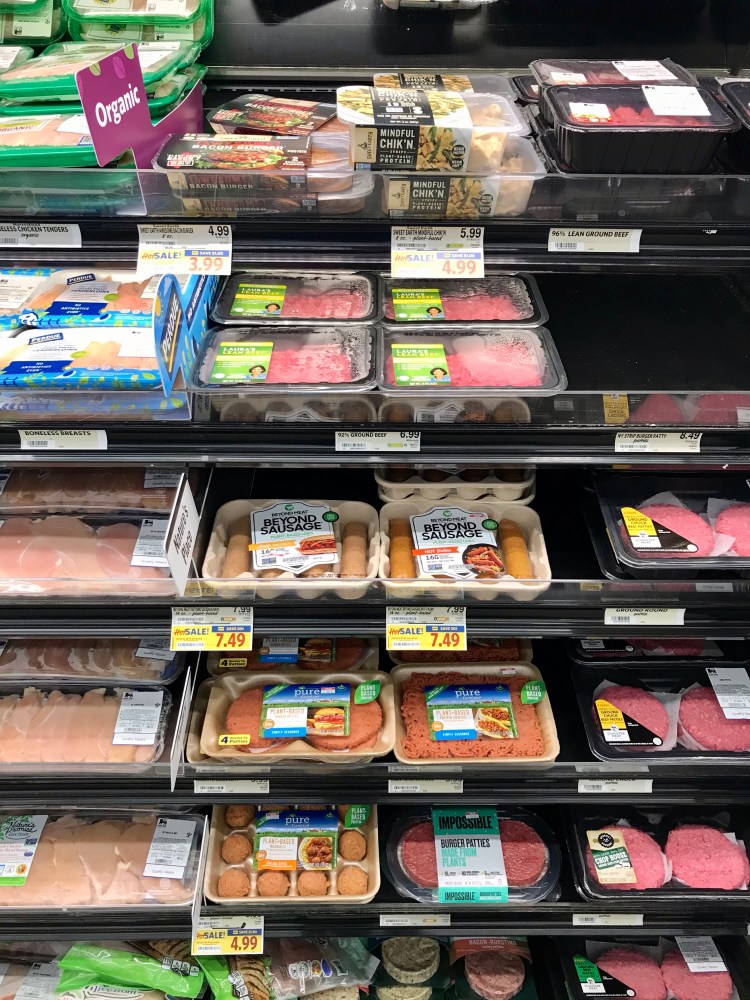
  • A surprisingly wide selection of vegan meat substitutes from multiple brands, including Beyond Meat, Impossible, Sweet Earth, and Pure.
Lots more choices than the urban store, which only had the Impossible burgers.
  • A wider selection of frozen vegan goods.
Check out these prices!
  • Organic sugar
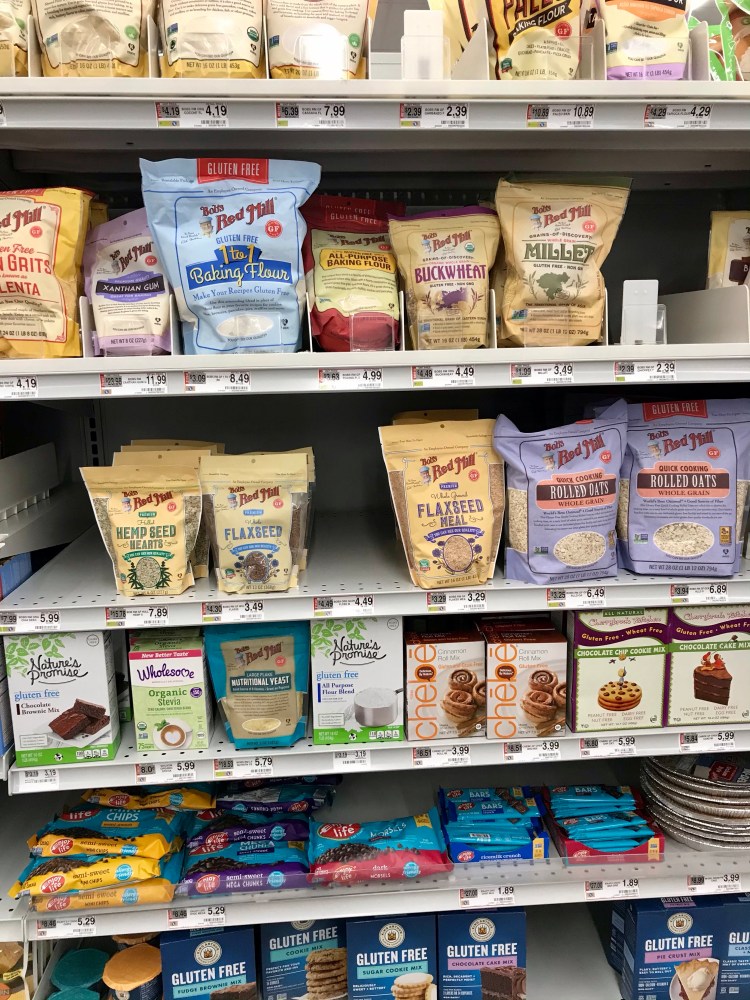
  • Enjoy Life chocolate chips and a wide variety of gluten free items from Bob’s Redmill.
Enjoy Life chocolate! Nutritional yeast and flaxseed meal!
  • A good selection of plant based milks, yogurts, and frozen desserts, including So Delicious and Ben and Jerry’s non-dairy treats. 
  • Just Egg at $3.99!
  • Vegan Helleman’s on sale for $3.79!
  • GT’s kombucha on sale 2/$5.00, which is a steal! 
My husband’s favorite!

Although I likely won’t return to the more urban location, I was impressed by the variety of vegan goods at my Ashland store. It was more on par with my big Walmart supercenter, which is just a mile or so away, and even had a few more things that Walmart doesn’t, most notably my favorite Silk protein milk and Just Egg. And the prices are outstanding! Although with the abundant array of grocery stores in Richmond with wider vegan offerings, I will likely still choose to shop elsewhere, but this may replace Walmart as my grocery stop if I need to pick up something in Ashland. It is nice to know that if Food Lion is one of your only choices, there are some solid vegan friendly options here.

Do you shop at Food Lion? If so, what do you like about it? I’d love to hear your opinion! As always, I hope you are safe and healthy.

The Power of Music

“Music expresses that which cannot be said and on which it is impossible to be silent.”

Victor Hugo

From a young age, I was captivated by music. My church, in particular, was very musical, as most are. We had a very strong music program, especially for the children, with multiple youth choirs. Even as teenagers, we regularly sang songs in Latin. Our adult choir had a tradition of singing pieces from Handel’s Messiah for Christmas services. I even considered majoring in voice in college. 

I learned early on to take solace in music. My first album? Wham. I was 9. Schooled by my brother as I grew older, he introduced me to the genre of alternative and indie rock. Not only did the music from these bands speak to me, liking these “cool” bands made me different. It distinguished me from the likes of the preppy New Kids on the Block crew. I happily embraced the outsider vibe, wearing lots of black and hanging out with the theater crew.

I quickly fell in love with The Smiths, REM, and The Cure. But The Smiths were my favorite. I followed Morrissey’s career into his solo days in the 90’s, a continuation of his broody lyrics and catchy tunes. I even saw him in concert in 1993. The magic of Morrissey’s lyrics combined with Johnny Marr’s guitar licks still speak to my very soul. As sad as it sounds, it made me feel better to know that I wasn’t the only unhappy person in this world, especially as a teenager. 

“Music is like a drug, but there are no rehabilitation centres.”

Morrissey

Of course, I’m disappointed and disturbed by Morrissey’s recent political leanings. I certainly don’t relish the rise in nationalism in America. I’m quite surprised that Morrissey has embraced the movement in the UK. I mean, he wrote the song “Interesting Drug,” with the lyrics, “There are some bad people on the right…” Sigh. I just don’t get it. But I also realize that he is an artist that the media loves to hate, so as much as I’ve researched his interviews, I can’t tell what comments are taken out of context. Regardless, wearing the logo of the nationalist party is pretty damning evidence of his support of the movement. 

But then he also gave us this line from “I Know it’s Over”:

“It takes strength to be gentle and kind.”

Morrissey

Like him or not, his practice of vegetarianism, later transitioning to vegan, is one of the things that inspired me to give up eating meat when I was 18. The more I read about the environmental impacts of industrial animal agriculture and what the animals actually go through in slaughter, the less I was willing to eat them. I haven’t had red meat or pork since 1993. I fully transitioned to vegan in 2017. 

As a Virginian in college in the 90’s, I also fell in love with the Dave Matthew’s Band, which was born as a collaboration of musicians from Charlottesville. I love so much of their music, with layer upon layers of instruments, compelling lyrics, and catchy tunes. Their music is just so substantive and rich. I was lucky enough to see one of their New Year’s Eve shows at the Hampton Coliseum in 1995. My favorite song by them is “Grey Street.”

“There’s an emptiness inside her. And she’d do anything to fill it in. But all the colors mix together to grey. And it breaks her heart.”

“Grey Street”-Dave Matthews Band

When I met my husband shortly after I started grad school, I loved the fact that he played guitar. It was a secret dream of mine to be lead singer in a rock band one day, and I had found my guitar player. His guitar skills were definitely a feature that wooed me. We also shared a love for Dave Matthews Band. 

My husband with our younger daughter. She was almost 3 in this picture.

I’m proud to say that my husband and I have passed our love of music on to our daughters. They both like most of my “old” music, but it’s my younger daughter who has caught the bug. As I’m writing the first draft of this post, she is taking her first guitar lesson, having learned as much as she can from her dad. She is already pretty good at playing the guitar, and she has an amazing voice. 

We had a heart to heart discussion around Thanksgiving about what she wants to do with her life. Her goal? To bring people joy. What a wonderful aspiration! I asked her if she wanted to help people manage their problems, etc, to make them happy? Nope. That’s not it. So, I told her, it’s art that really makes people happy. My daughter, it seems, is destined to be a performer. I can’t wait to take her to her first concert once Covid is over. 

I’ve recently been helping my younger daughter acquire vinyl albums to add to her collection. It’s been great fun to search for these together! On a recent day trip to Charlottesville, we stopped at a used music store called Sidetracks. You always hope to find something special, but while flipping through the “collector’s bin,” I stumbled upon a 12” single of The Smiths “How Soon is Now,” with “Well I Wonder” and “Oscillate Wildly” on the B side. The owner of the store played it for me, and I actually welled up in tears. It did, indeed, come home with us. 

My purchase! The Smiths “How Soon Is Now” 12″ single. 1985.

Of course, I’m thrilled that as I’ve aged, the alternative genre has become more mainstream. I do enjoy some of the newer artists, but I will forever be tied to the music that brought me through my teenage and young adult years. 

When I’m happy, I play music. When I’m sad, I play music. When I’m in my car, I sing. I cherish my CD collection. I adore live music, but don’t go to concerts as much as I’d like. I can’t run alone without playing music. I believe that when I’m old and feeble, living in a nursing home somewhere, I will still have cherished music from The Smiths, REM, and Dave Matthew’s Band to keep me company. 

Is music a part of your soul as well? I find it an essential part of my spiritual wellness. What music speaks to you? I’d love to hear about it! As always, I hope you all are safe and healthy. 
About Texas…

Wow. Am I happy that I don’t live in Texas right now. Not that we haven’t experienced our fair share of winter weather and power outages in Virginia, but my state seems far better prepared for weather extremes, thankfully. 

By now, we’ve all seen the viral pictures of the disaster in Texas. Water gushing out of homes from burst pipes. Icicles dangling from ceiling fans. Exhausted pizza makers at Domino’s, which was one of the few places open to buy food. Lines of cars waiting for bottled water. Empty shelves in grocery stores. Bathtubs full of snow, waiting to melt so residents can actually flush their toilets. Definitely not a situation we would expect in the US. I can’t even imagine the desperation of these circumstances.   

We’ve got two different issues going on here. One is climate change, the other is a catastrophic failure in government regulation, as the state of Texas chose long ago not to participate in the national grid. There are exceptions on the fringes of the state, but for the most part, 90% of the state’s electricity is privatized.  

Let’s address climate change first. I know, I know… it’s been cold in Texas. Not just cold, but frigid. This seems counterintuitive to what we have heard about the dangers of climate change, which is typically all about global warming. And, yes, we have the heat to blame for dry conditions, brutal summers, severe fires, and intense and more frequent hurricanes. But bitterly cold temperatures and winter storms? So, what’s the deal? I asked myself the same question. 

Apparently, as the poles of the earth warm, arctic air becomes energized, causing significant fluctuations in the jet stream. The jet stream is the major current which propels weather systems in a generally west to east pattern, and it’s typically very powerful. So powerful, in fact, that flights to the west coast are slower than the trip back east. 

But with a weakened jet stream, the polar vortex has an opening to drift south, wreaking havoc on our typical weather patterns. This is how we ended up with a major winter storm in Texas, of all places. This happened in 2011 as well, with dire results. That should have been a wake-up call to utilities management, but recommendations to winterize the Texas grid were voluntary and expensive. So in great capitalist fashion, profitability won over consumer safety. 

But, wait, isn’t our government supposed to provide structure and regulate our power utilities so that major outages due to safety issues don’t happen? Well, yes. And if you live anywhere else in the US, that is the case, as the rest of the grid falls under federal legislation. However, our infrastructure as a whole is in need of a major overhaul. I mean, what does it say about our grids when in the year 2021, the only way we can avoid total failure when demand for energy is at all time highs, such as a severe heat wave, are rolling blackouts? And, thinking more locally, how many of you live in communities where newer neighborhoods with underground power lines never lose electricity, while older neighborhoods with above ground lines are significantly more vulnerable to power outages? 

Getting back to the situation in Texas, the failures there have nothing to do with limitations in renewable energy, as some have claimed. It has to do with frozen natural gas pipelines and a grid that is not built to withstand freezing temperatures. On top of that, rolling blackouts intended to avoid overwhelming the system are ongoing, too. 

Texas decided to stay off the national grid way back in 1935 to avoid federal regulation. As previously stated, 90% of the state utilizes this grid, while some counties on the fringes of the state do not. The current company managing the grid, ERCOT, formed in 1970, continuing the tradition of avoiding federal regulation, opening the door for safety issues in the name of increasing profits. In fact, it’s so profitable right now due to jacking up natural gas prices from high demand, that the major stockholder in the game is reveling in his “jackpot” moment. Is it really all about money? What about the 47 people in the state who have died so far in this crisis? What happened to taking care of your customers and helping those in need? Sigh. 

This is clearly a case of where small government does not work. When we let capitalism run amok, this is what we get. Greed, ignoring the safety of citizens, and catastrophe. It’s the same story in Flint, Michigan. These are preventable crises. 

We now have a crisis on top of the crisis of the pandemic. How is anyone managing to stay sane when they have to struggle to merely survive? There’s only so long one can exist in a fight or flight state. 

Are basic human needs a right, including access to affordable power? Or are these to remain luxuries for the rich? I mean, who can afford a power bill of several thousand dollars? It seems the owners of the grid are laughing all the way to the bank. President Biden has declared a state of emergency for Texas, ordering federal assistance for recovery, and multiple lawmakers from other states have led the charge for raising funds and organizing distribution of goods to the citizens of Texas. 

Of all the things we need to worry about to maintain our wellness, at least in the US, we shouldn’t have to be concerned about the stability of our utilities, especially in the midst of evolving climate change. Yes, this time, the utility crisis was in Texas, but it could happen anywhere. Although it seems we are powerless to prevent these issues, it’s important to let your voice be heard. Contact your local, state, and federal legislators and let them know that you want to ensure the safety of our utilities infrastructure. These are things that we take for granted until they don’t work. If you are in Texas and are affected by this crisis, I’m sending you love and light. As always, I hope you all are safe and healthy.
Grocery Store Tour Series for Vegans: Target

Yes. That Target. The same one with the fancy designer clothes and home goods and the super fun dollar section. And although not every Target has the real grocery department, granting it the title of PFresh Target, we do have two close to me that have that distinction. 

Of course, one can’t possibly do their primary grocery shop at these Target stores, but they have some wonderful vegan friendly items if you are already in the store anyway. They may even have more variety than you expect. And, let’s face it. Who doesn’t love a Target run?
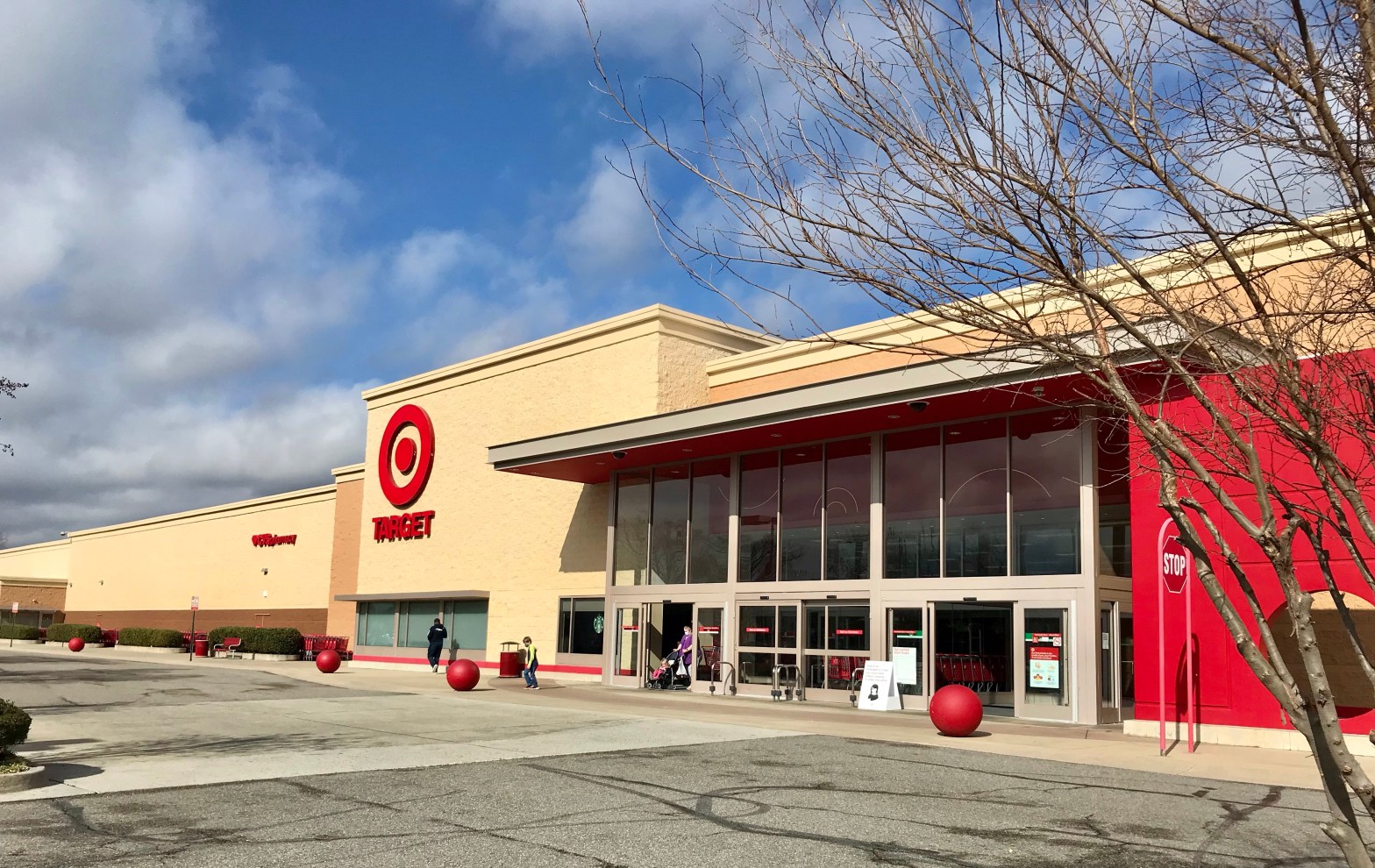
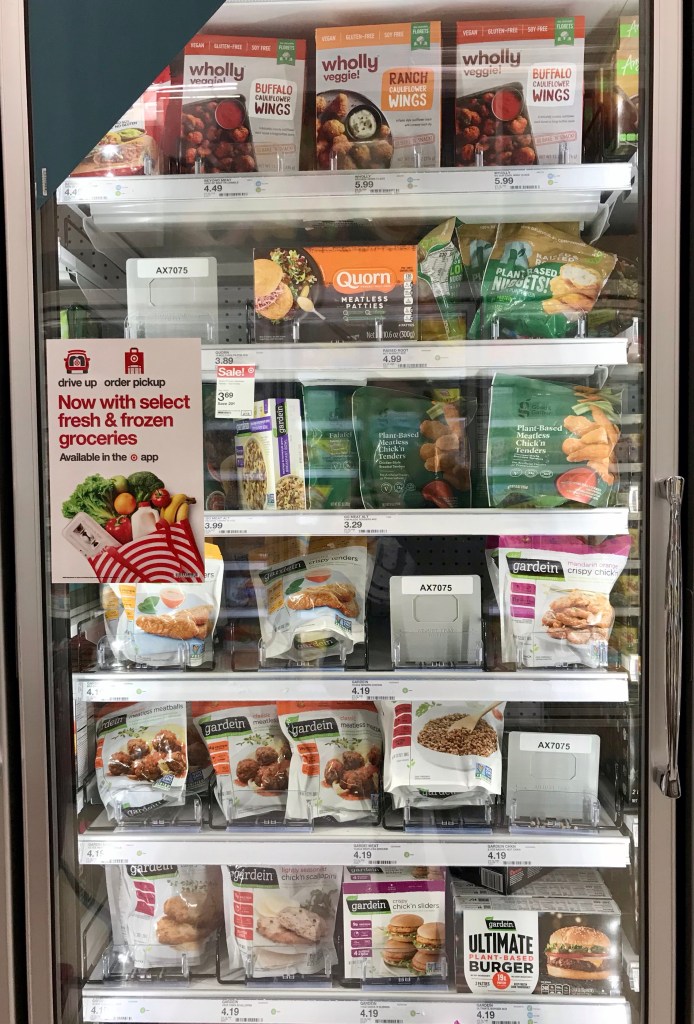
Target PFresh stores have all the basics. There’s pasta (even Banza!), canned beans, jarred pasta sauce (including my favorite by Rao’s), canned veggies, bread (even Dave’s!), refrigerated juices, and frozen basics. They do have some basic produce items like bananas and avocados. What you may not expect is the variety of plant based items in their refrigerated and freezer sections. 

The produce and meat section of my local Target store with the PFresh format.

Here’s the unexpected that they have:

Miyoko’s products

  • This vegan “dairy” line is wonderful. My Target grocery carries their plant based butter, roadhouse style spreadable “cheese,” and vegan mozzarella. The mozzarella is grateable and is a great addition to my homemade pizza!
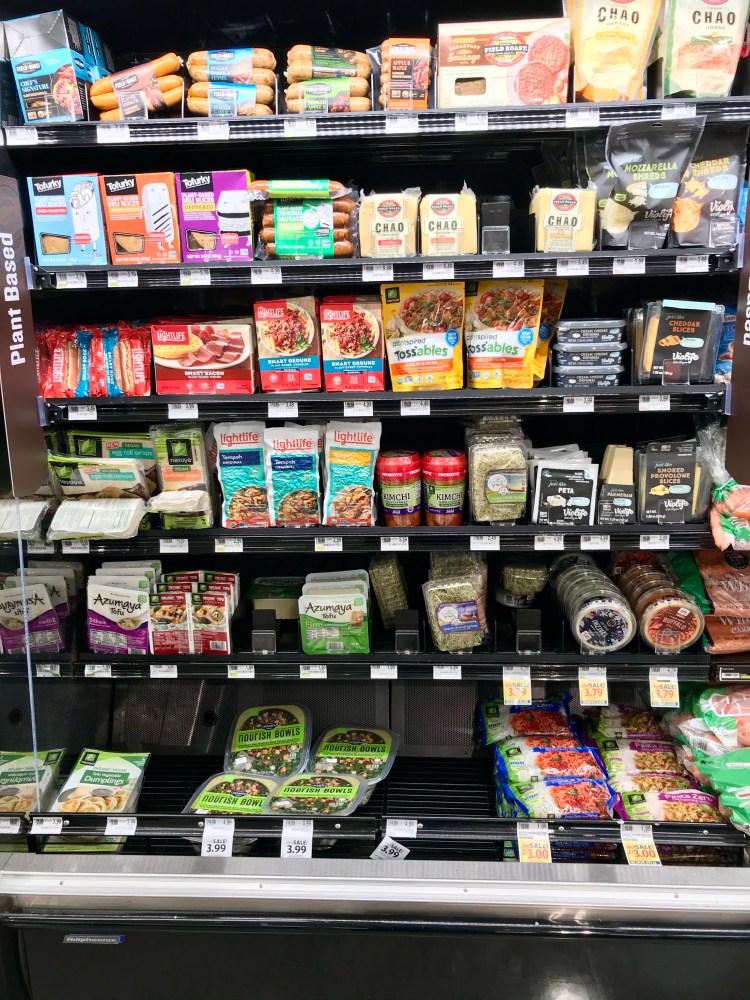
There is a nice selection of tofu, meat substitutes, plant-based dips, and Miyoko’s products.

Plant-based meat

Beyond burgers and grounds as well as Impossible grounds.

Tofu

  • Hodo seasoned tofu products
  • Organic tofu

Plant-based milk products

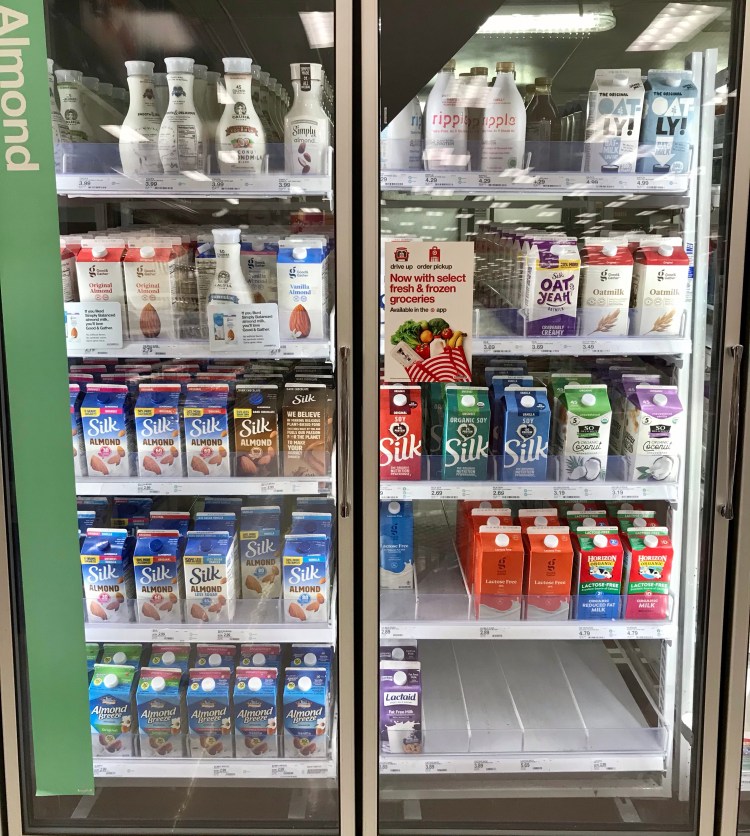
  • They carry a variety of brands of plant based milk, including Silk, Almond Breeze, So Delicious, Califia, and Target’s store brand, Good and Gather. They even have my favorite: the plain Silk Protein milk.
  • Target also carries a few types of non-dairy creamer!
  • They also have a decent variety of non-dairy ice cream, including their own store brand, So Delicious, and Ben and Jerry’s. I also found the plant-based Kind ice cream bars (totally worth the calories, btw.)
  • Vegan yogurts by So Delicious and Silk.
  • Daiya cheese slices.
The plant based milk case at my local Target.

Vegan friendly items for baking

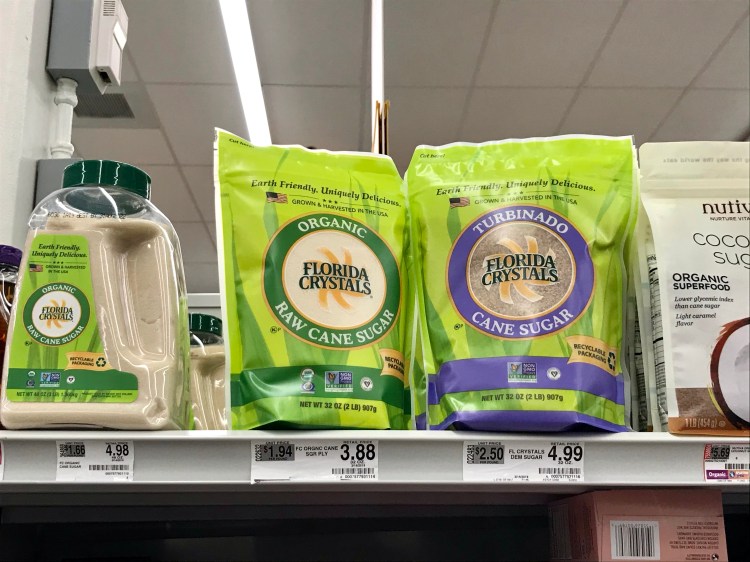
  • Organic sugar. Since regular sugar is assumed to be processed with bone char, it’s a safer bet to purchase organic varieties. 
  • Bob’s Red Mill products, including egg replacer and nutritional yeast.
  • Enjoy Life chocolate chips
  • Toll House allergen free chocolate chips
A variety of organic sugar here.
Enjoy Life and Toll House allergen free chocolate chips are here!

Frozen vegan meals

  • Gardein products are here!
  • Target’s store brand Good and Gather has frozen “chicken” nuggets and tenders.
  • Sweet Earth vegan meals
  • Fat Rabbit vegetarian meals (reading the ingredients, some varieties are vegan, but are advertised as vegetarian)
One of a few cases with frozen vegan friendly items.

Dave’s Killer Bread

  • They carry all the breads, bagels, and buns! My favorite national brand for bread. All are vegan except the cinnamon raisin bread.

Most Target stores do have a selection of grocery basics, even if they don’t have produce. But the produce section is your clue that the location is a PFresh Target. I love that there are a few items here that I can’t find anywhere else, and that will keep me shopping at these stores!

My grocery selections this trip. They had a sale: buy 3, get one free plant based proteins.

What’s interesting about Richmond and the grocery landscape here is that we have so much variety! In the same shopping center as this Target store I visited for this post, there is a Food Lion and an Aldi, and, across the street from these 3 stores, a Kroger Marketplace. That’s a lot of choices! We are indeed lucky in the RVA!

I’m posting a day early just in case we lose power tomorrow due to the expected ice storm. As always, I hope you all are safe and healthy!

The N95

When I was in high school, I took driver’s ed, of course. And my teacher talked about using bright lights. And since we lived in a city, he predicted that it would be about 3 years before we would ever need to use these. He was wrong. I found myself driving with my dad out in the country shortly thereafter, and I actually needed to use my bright lights. 

I remember feeling slightly weirded out by the fact that I needed my high beams. I mean, I had a reasonably responsible adult who told me I wouldn’t need them because of where I would be driving the most. And it was odd that he was wrong. 

I’m feeling the same sense of wow about using an N95 mask on a daily basis at work. This once rarely utilized piece of PPE has become a daily part of my uniform. As normal as my color coded scrubs to indicate with which team I belong.  It’s definitely a strange yet important time to be a healthcare provider. 

Before the pandemic, this was a piece of equipment you were fitted for once a year or so. It was something that you had to check off of your annual competencies and safety checklists, much like reviewing infection control measures and OSHA guidelines every year. A necessary afterthought. We all took our masks home with us and, if you’re like me, stuck it in some pile of stuff somewhere with things that you’d likely never need, but were too important to toss. 

While being fitted, which consists of asking what size you were last time, putting that size on, putting a tent over your head, and squirting a bitter saccharin solution mist into the tent to see if you can taste it, we often would ask others in line for this process if you’ve ever had to use one. Often it was never. I actually treated a patient in acute care a few years ago on airborne precautions for the measles. I was the frequent winner of the N95 wearing contest for wearing one one time in my 21 years of practice. This past year has changed that oddity for every healthcare provider and for our support personnel. 

Never in my wildest nightmare did I think that I would have to become so intimately acquainted with the 3M size small N95. It leaves me with strap marks and a bit of redness once it’s off, often lasting for hours after doffing it. For a long while after my work day, I feel like I’ve had a suction cup over my mouth and nose. I guess it kind of looks like that, too. 

Hours after taking off my N95, you can still see the imprints of the mask and straps.

If that’s not enough, I also double mask and wear goggles. The double masking  keeps the N95 cleaner. And as an added bonus, if I do go into a contact or airborne precaution room, I can just replace the level 1 mask on top. The goggles were added as another layer of protection in September when it was discovered that the coronavirus can also enter the body through your eyes. It’s a lot of gear to wear all day, and I’m only treating COVID+ patients occasionally. Working with these patients also also requires a plastic gown and face shield.  

Goggles and double masking are routine in Covid times.

I started my current job in August, right smack in the middle of the pandemic. It’s been so difficult to learn who everyone is and to match faces with names. That’s the weird part about starting a new, in person job during this ongoing crisis. I don’t often get to see everyone’s faces during our socially distanced lunches. But I’m getting there!

I feel very fortunate to have adequate PPE right now to protect both my patients and me.  It gives me a great sense of peace and safety when I arrive to work and find my little brown bag with a fresh N95. I’m also grateful that the days of having to recycle our masks to wear again are also seemingly over. And I’m super grateful to work with the team of colleagues of which I am a part. 

But the next time you’re out at the grocery and you see someone in scrubs trying to fit in that after work run for necessities, know that they have likely had a long day serving others in less than ideal circumstances. We’re a bit weary of wearing these fitted N95’s. 

Please keep encouraging everyone to do their part. Get vaccinated if you can. And wear your mask! Maybe one day, our lives can return to something closer to normal. 

Have you ever worn a fit tested N95 for an extended period of time? How is mask compliance in the community where you live? I’d love to hear about your experiences. As always, I hope you all are safe and healthy.