
Trauma Changes Everything
A deer roams in our backyard. The doe is stunning. And as she carefully surveys her surroundings, she signals for her babies to follow. They emerge from the woods, keeping close to Mama, their white spots indicating their infancy.
They begin to pillage the green leaves emerging as spring has possessed the landscape. Attracted to the tender new growth of our azalea bushes and hostas, these are tasty treats for them.
I gently open the back door to take a closer look at this cute family. Mama pops her head up in alert, staying still, and listening intently. She sniffs the air and senses my presence. One of her ears twitches. Despite my best intentions, she reads me as a threat. Her white tail rises, and all three suddenly bolt back into the safety of the dense forest behind the house.
Fight or flight. Animals seem to live in this constant state, forever some other creature’s potential prey. They must to survive, right? I can’t imagine living like that.
But in reality, I already do.
Humans who have survived trauma can also exist in a constant state of fight or flight. It is in this way that experiencing trauma can permanently alter the brain.
How can anyone actually survive like this? It’s simple. Just like people with persistent pain learn to live with discomfort, those who are living with PTSD or cPTSD learn to tolerate a baseline level of anxiety.
I wasn’t aware until I underwent intensive trauma rehab how hypervigilent I had been my entire life. I thought it was just a normal state of being.
Do you know what this is like? If you always think you will be in trouble for something, if you walk on eggshells around certain people, if you take time to read the room carefully before acting, and if you feel responsible for the behavior of others toward you, you may be a trauma survivor.
As I learned in rehab, there can be big traumas (Big T trauma) or small traumas that accumulate over time (Little T traumas). And the unluckiest of humanity experience both, and in multiples.
Big T traumas are the obvious: molestation, rape, suicide or murder of a loved one, surviving a natural disaster or war. Big events like that. These events can cause PTSD (post-traumatic stress disorder).
Little T traumas are more nefarious: bullying by your peers, parents who are overly critical or helicopter, or having to become a caregiver early in life among others These are the little jabs that accumulate over time and shape your daily thought processes. These can cause cPTSD (complex post-traumatic stress disorder).
I often contemplate if wild animals feel burdened by hypervigilance. And what about those animals raised for human consumption? Surely these creatures feel the effects of this stress.
When I go for a walk or run and encounter a bird or some other beautiful creature, I want to stop and watch them, but they almost always run away. Who can blame them?
They are obviously scared and have no idea I wish them no harm. But what must it be like to live in a constant state of readiness to flee?
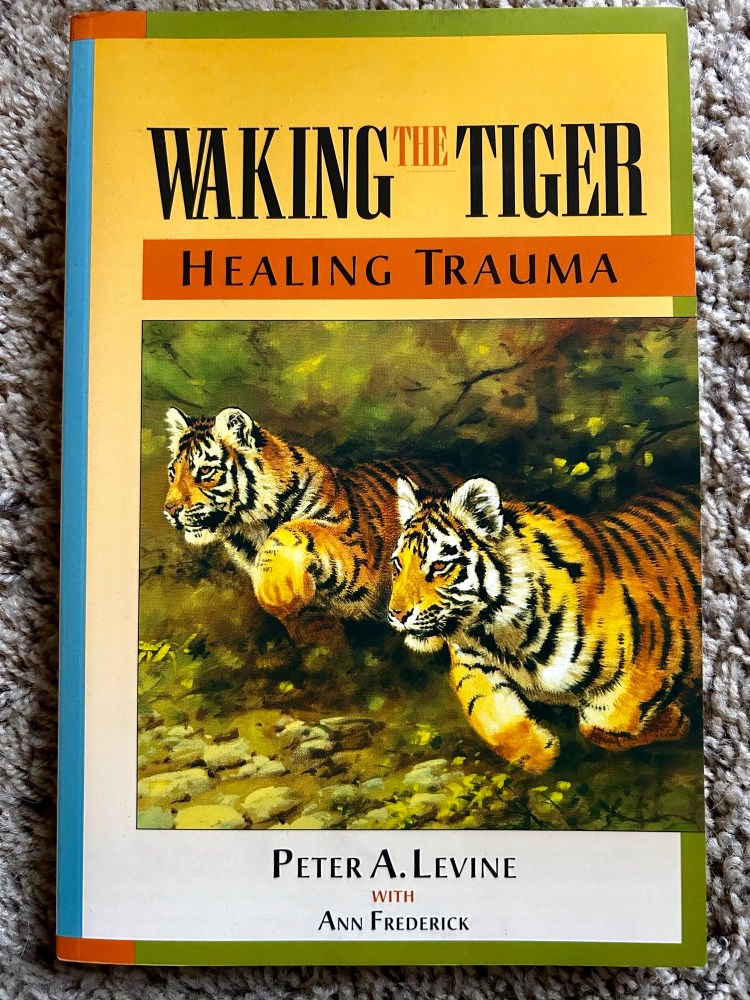
Reading the book Waking the Tiger: Healing Trauma by Peter Levine, Ph.D., I learned something different. He did not confirm my hypothesis. He explained that animals lack the reasoning brain of humans; the part of our brain that keeps the score, so to speak.
When a human experiences a traumatic event, our reasoning brains work hard to protect us. Sometimes we never move out of a state of panic after the event; our brains are permanently altered.
Post-trauma, we can get stuck in our own special version of hell, with our nervous systems on high alert and living our lives in survival mode.
Captive animals, like our beloved dogs and cats who are well taken care of, typically live longer than their wild counterparts. Of course, multiple variables contribute to this trend, but I can’t help but think that the lack of cumulative stress of worrying about predators or finding food helps improve their longevity.
Imagine what it would feel like to have all of your needs met, feel true safety in your environment, and never suffer abuse or hunger. This is the life of my pets, anyway.
Now imagine a different life as a captive animal raised for consumption.
You are a chicken or a pig or a cow, and your best friend has been yanked from the herd or flock. You have no idea where they went, but you realize they never return.
Imagine that creature is taken from their family and friends, perhaps from horrid conditions, now find themselves crammed into a small shipping cage with other animals like them, and they are scared, jostling around on the back of a truck, and exposed to the elements.
It might be summer and super hot. It might be winter and bitterly cold. It may be wet from rain. They may die on their way to slaughter. But maybe they survive, get to their final destination, and suddenly realize what is happening.
They smell blood. They sense fear, and they absorb the signs of death.
They may cry as they make this realization. Fight or flight is king.
The only recourse for these ill-fated creatures is that their brains will push them into freeze mode at the end, the brain’s way of shielding us from suffering.
People do this, too. Have you ever heard a survivor of sexual assault talk about staying still and doing nothing in the face of their attacker? Their brain tried desperately to keep them from feeling the pain, literally paralyzed by fear. Just as an antelope goes limp in the jaws of a lion, a victim of assault can unintentionally surrender to what her brain deducts will be her fate.
Freeze mode, a reaction from the more primitive parts of our brain, is just as protective as fight or flight.
While animals can resolve the stress of immediate danger and move on, humans can trap these feelings and hold onto them forever, pushing them into deeper levels of our minds, just waiting for a trigger to pull them up to the surface.
“Although we rarely die, humans suffer when we are unable to discharge the energy that is locked in by the freezing response. The traumatized veteran, the rape survivor, the abused child, the impala, and the bird all have been confronted by overwhelming situations. If they are unable to orient and choose between fight or flight, they will freeze or collapse. Those who can discharge that energy will be restored. Rather than moving through the freezing response, as animals do routinely, humans often begin a downward spiral characterized by an increasingly debilitating constellation of symptoms.”
― Peter A. Levine, Waking the Tiger: Healing Trauma
Peter Levine, Ph.D., proposes that we can overcome deeply embedded trauma through some rather unconventional methods, and he is a senior fellow of the rehab facility where I was treated.
I have now undergone somatic experiencing therapy along with EMDR (eye movement desensitization and reprocessing) and ART (accelerated resolution therapy). The purpose of these is to revisit the scene of the trauma, replay them, and reframe the ending of these stories. In a way, you are consciously playing out scenarios in your mind and creating better, more advantageous outcomes. A sort of finalization and resolution of any ruminating thoughts you may have about the event, and discharging all of the emotion related to it.
For someone riddled with anxiety and ruminating thoughts, it seems like a rather indulgent and counterintuitive exercise. But for some reason, having someone guide you through the process and actually reach a point of closure does seem to help.
The pain of trauma can lead people to some rather destructive ways to cope, including substance and process abuse. This is why it’s so important to get help. And no matter what your brain tries to tell you, you deserve to heal.
___________
If you have survived trauma, don’t wait to get help. The sooner you face the demons after the event, the better tools you will have to deal with it. No one deserves to be miserable. And most miserable people you meet have buried an extraordinary amount of trauma in their souls.
Children in public schools can usually get help through school counselors.
Young adults in college can typically get these services for free through campus counseling. Both of my college-age kids take advantage of this.
If you work, most employers have short-term counseling services available through an EAP, or Employee Assistance Program. This is a great place to start.
Get the help you need. It’s worth it. You deserve it. Stigmas, be damned.
As always, I hope you all are safe and healthy.
 Anne the Vegan