What Smells Like Skunk?

Has my olfactory system betrayed me?

Wandering the streets of Downtown Chicago after dark with friends, I suddenly catch a whiff of a familiar, yet unpleasant smell.

“Why does it smell like skunk? Are there really skunks in the city?” I queried. 

(In my defense, we legit saw a red fox hanging out by the Bean sculpture during our visit, so the possibility was not out of the question.)

“Anne, that’s not skunk,” says one of my friends. “That’s weed!” she explains. 

Oh, wow. I was clueless. I thought my nose knew better. 

Proof of our encounter with a red fox in Millenium Park in Chicago, home of the infamous bean sculpture. Photo by author.

Perhaps my two bouts with COVID and its seemingly temporary alterations to my senses of taste and smell were more of a permanent disablement, even though the bland world without the joys of these experiences did seem to subside.

I realize that so many scents in my world smell like skunk to me now: skunk (obviously; and living out in the country, we smell this a lot), coffee brewing (unfortunate, I know.), car exhaust, sometimes poop (a smell encountered frequently as a healthcare provider and equally unfortunate), and now weed. 

My therapist seemed intrigued by my description of the smell of my internal adrenaline rushes, which I describe as “acrid.” As a child, I experienced a similar smell when I tried to fathom the concept of an infinite universe; it’s as if my brain burned with the effort to comprehend it. 

She asked me if I’ve always been sensitive to smells, but I couldn’t remember at the time. 

After I thought about it some more, I recalled that a smell often takes me back to a place in my past. Running near the Sauer’s spice factory in downtown Richmond sends me to the spice shop on St. John in the USVI. It’s a pleasant throwback. Or walking into someone’s home that reminds me of my grandma’s house. Or how something I brought out of my suitcase on vacation still smells like home (and if I’m lucky, also adorned with cat or dog glitter).

The other question my therapist asked was if I was sensitive to perfumes. This I could positively confirm. 

There was that disgusting Giorgio perfume back in the 80s that everyone wore back then; that and its designer imposter counterpart. Trapping me in a room with someone doused with that concoction surely equaled a headache for me. 

But now, at work, there’s a guy who stocks our supply closets and simply smells divine. I always conveniently have a supply need when he’s stocking. (If you smelled him, you’d understand.)

And I love that song by Twenty-one Pilots about being stressed out. Do you know the line about the scented candle? Yes. That one. About making a candle that smells like home. What a great idea for a side hustle. 

Do you know that retail chains pump signature scents into their stores? Like every Wawa bathroom smells the same. The Gap locations smell identical. So do Abercrombie and Fitch stores. The list goes on. That shit is purposeful. 

Compared to the pleasant aromas at the mall, the grocery store can be downright revolting to me, especially near the seafood and meat departments. It makes me want to vomit every time I smell that rank fishiness. It’s an area where I’ve learned to breathe through my mouth, not my nose. 

But some smells bring me comfort, like baking bread, the cinnamony scent of my cat, the familiar and not unpleasant smell of my dog, books, and how my husband’s cologne mixes with his chemistry. 

Perhaps my favorite scent is the magnolia flower. I wish I could bottle it and wear it. Prevalent Virginia, it’s always a great time of year when these trees are in bloom. I often plan my runs to pass areas where these trees live. 

A baby skunk that got trapped in our trash can. Poor thing! We facilitated a great escape for him. Photo by author.

What continues to be most fascinating about my olfactory system is its perception of the smell of skunk and how it simply groups that with the scent of so many seemingly unrelated things. 

Maybe my nose is a traitor.

At least when my daughter and I traveled to London this summer and encountered that skunk smell in multiple US airports and the streets of London, I knew what it was! And it was definitely not skunk. 

___________

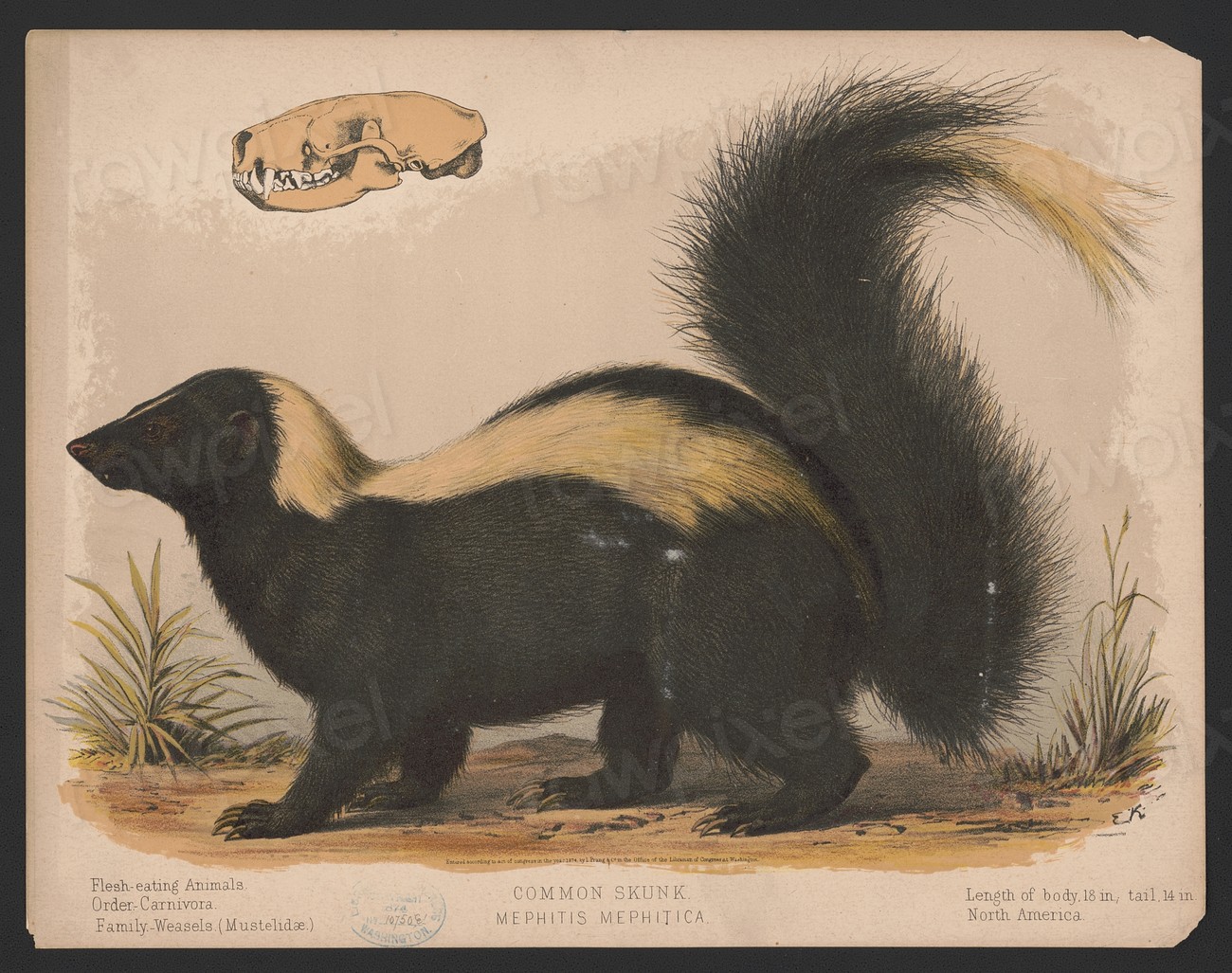
Lead photo of a skunk free from Openverse.

Are you sensitive to smells? And does your nose play tricks on you, too? I’d love to hear about it!

As always, I hope you all are safe and healthy. 
What White People Need to Hear About the Confederate Monuments

I thought this was old news, but apparently not.

Newspapers are a long-forgotten medium in our modern world. But I happened to spot a copy of the New York Times in a moment of boredom and realized it’s still a unique source of connection to the world around us.

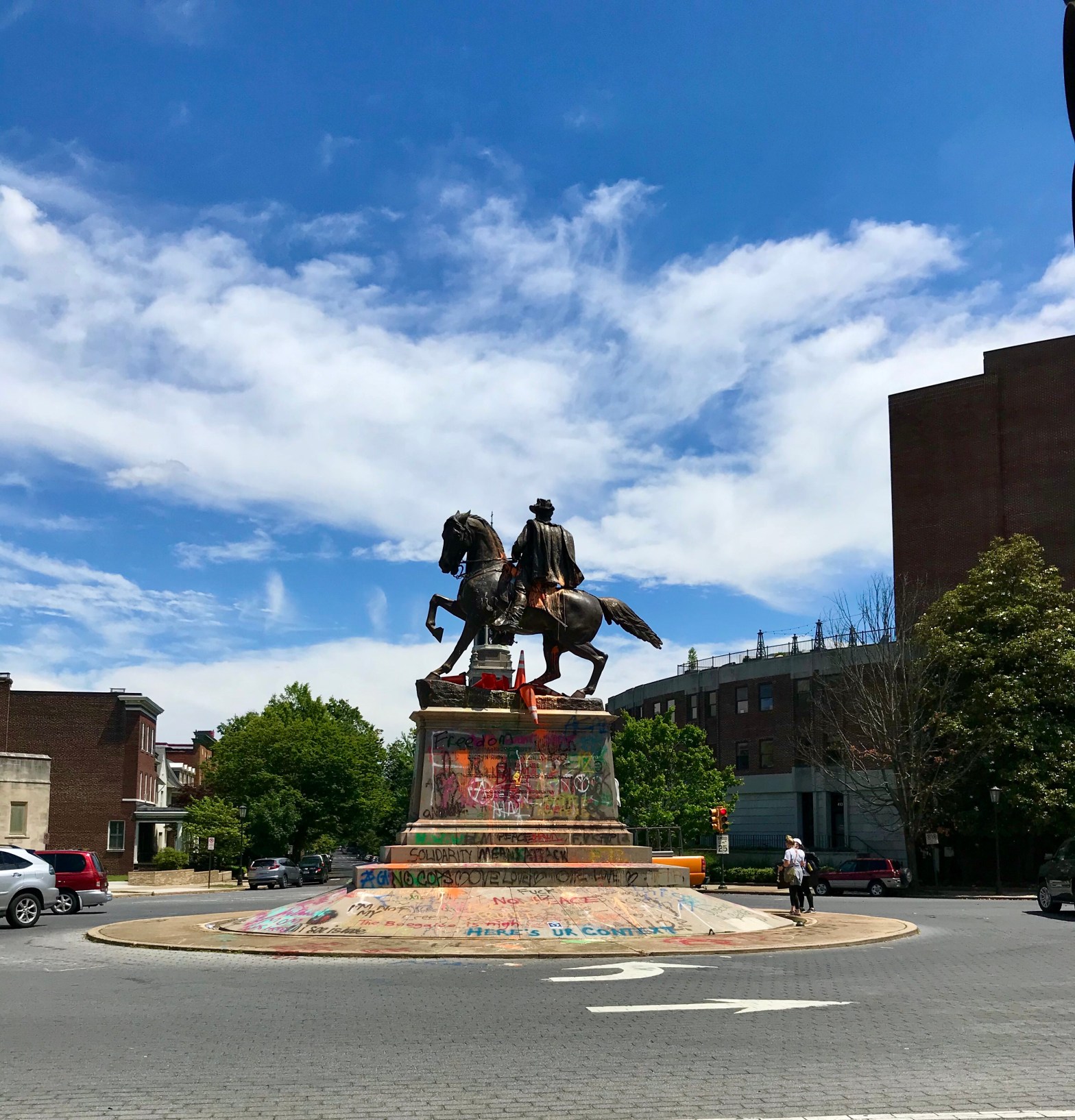
A giant statue of General Robert E. Lee graced the cover of the commentary section that day. It looked so familiar. I could have sworn it was a photo of the one that once stood on Monument Avenue in Richmond and became a living work of art during the protests for George Floyd. I was somewhat surprised to find out that this one was in Charlottesville. 

Although different artists made the Lee monuments that used to stand in these two cities, many bronze Confederate statues were manufactured by the same company, with one design being replicated repeatedly and spearheaded by the United Daughters of the Confederacy. This is why so many monuments look identical

I frequently run in The Fan, Richmond’s nickname for the area that includes Monument Avenue. I loved watching the evolution of the Lee Monument during the protests. I was thrilled when the monument was removed on September 8, 2021, watching the process live on TV. The statue was erected in 1890.

The Lee Monument in Richmond became a living work of art during the protests in honor of George Floyd, Breonna Taylor, Amaud Aubrey, and other victims of racial violence. Photo by author

The Enlightening

Recently, as I was sitting and waiting for a meeting to begin, I overheard a conversation where a white man lamented about “erasing history” by removing the Confederate monuments. Someone piped up and agreed with his statement. 

I couldn’t keep my mouth shut. 

“Um… do they have statures to Hitler in Germany?” I asked. 

“Well, no. That would be ridiculous,” he stated.

“Then why would you think honoring someone who actively fought to maintain the dehumanizing of an ethnic group be OK here?” I argued.

“Well, this is different.”

“Is it? I would ask you to try to see the from the perspective of the oppressed.”

“Huh. I’ve never considered that before.”

“Well, maybe you should. I think some aspects of our history should not be honored.”

“But these monuments are tremendous works of art!” he continued.

“But are they really? Think about when these monuments were erected all over the South, especially. It was in the reconstruction era with another push in the 1950s, the height of the Jim Crow era. And all of the monuments looked exactly the same. Same mold. Did you think they perhaps were erected simply to reinforce the fear of the formally enslaved?”

“Oh, wow. I’d never thought about it like that before.” 

I had won my case. 

Why Speaking Up Matters

There happened to be a person of culture in the room who overheard this exchange. She approached me after the meeting, thanking me for saying something. She felt validated in my defense of the removal of those awful monuments. 

“There’s no way it would have gone well if I had tried to explain it to him,” she said.

“Well, sometimes white people have to hear their stupidity from another white person. It makes it more palatable when they are called out on their bullshit, unfortunately. Maybe next time he will reflect a bit before he speaks.”

This exchange was the beginning of a great friendship. All because I dared to speak up.

As much as I have run on Richmond’s Monument Avenue over the years and have observed its legacy of intimidation, I often joked that the only time I was glad to see Stonewall Jackson was on a run because that typically marked our turn back to our cars. Now that turn is no longer marked by that statue. 

The empty pedestal of what once held a statue of Robert E. Lee in Richmond, VA. Photo by author.

Next Steps

We aren’t finished cleaning up the legacy of the Confederacy here in Virginia. 

In my county, which is outside of the city and far more conservative, a measure to rename two schools in the county from Lee-Davis and Stonewall Jackson was barely passed in 2020. The three “progressive” appointed school board members who helped spearhead the movement were quickly removed by the board of supervisors. 

Confederate flags still plague the landscape here. Racism runs deep in Hanover. 

There’s a lot to reconcile as a daughter of the South, as I can trace my ancestry to original colonists in Virginia in 1610. However, I plan to be a part of the healing process rather than a carrier of the legacy of abuse. You can, too. 

___________

Lead photo of the Jeb Stuart Monument in Richmond by author.

Staying silent equals compliance, and apathy is the enemy of democracy. 

We can all work for better equality in this country. Activism doesn’t have to look like protesting in the streets. It’s also simple measures like emailing or calling your representatives. Don’t be afraid to let your voice be heard. 

As always, I hope you all are safe and healthy. 

Guns Are Not Toys

A Poem

Guns are not toys.

Guns are not fun.

Just look at all the harm they have done.

My life is a mess.

Improving, at best.

I have no more demons to confess.

Forever impacted

By this event protracted.

A smudge in my life that should be redacted.

I went to prison

While you lived your life.

Now I am back to continue this strife.

I am smart.

I am kind. 

But I’m leaving that other woman behind.

I rise anew

From ashes askew.

A phoenix has risen, proud and new.

Impervious to pain,

My past, it has slain.

And I will never be crossed again.

I’m letting go

Of the shame, guilt, and regret

Desperately trying to adopt a new mindset. 

But please forgive me if I make some mistakes. 

Because this is my life

For as long as it takes.

___________

This poem simply poured out this morning.

Enjoy.

As always, I hope you all are safe and healthy. 

Run the Mile You’re In

My new mantra for life as I learn to live in the present.

A wise running coach once taught his marathoners that when the run gets tough, just run the mile you’re in. 

It’s such a simple metaphor for life, right?

I mean, how much time do we spend ruminating about the past while simultaneously future-tripping? 

This was my life before trauma rehab. And, yes, it was exhausting. I still have to pull my brain out of those old thinking patterns consciously, and it’s tough. 

If we think about this metaphor for running an actual marathon, it’s easy to build the story about this journey. 

Perhaps you didn’t prepare well enough for the race, making mistakes in prep like not training properly, eating poorly in the days before the race, or walking up late that morning. 

Maybe you are too worried about what happens after the race. Will there still be pizza and beer when you finally finish? How far is the walk to my car? Did my car get towed? Will my family be on the route? 

But inevitably, your mind will become very preoccupied with pain, especially as the effort of running those miles piles onto your body. It helps to try to shift your thoughts toward what is in the present. Observing your surroundings is just one way to do so. 

Grant me the serenity to accept the things I cannot change…

What, exactly, are these things? The weather, for one. The challenge of hills on the route. The presence of crowds or the lack thereof. 

The courage to change the things I can…

You are certainly responsible for your attitude. Easier said than done when your legs are screaming, begging you to stop your efforts. I will typically keep repeating to myself, “One foot in front of the other. Every step is closer to the finish.” 

Can you change how tired you feel? You can use your supplements, take in water and electrolytes, or take a walk break, all of which can improve the fatigue factor. One of my favorite glucose replacements is a fun pack of Skittles, which I always look forward to eating! 

Music can also inspire you to keep moving. I will use music as a reward in the final miles of a run to help keep me motivated to move forward. 

And the wisdom to know the difference. 

Enough said. 

One of my happy places is among the salt marshes of coastal South Carolina.

In life, there are many things we cannot change. Especially what other people think of us. We also can’t relive our childhoods and hope for better. We can’t change how people hurt us in the past or the resulting injustices. 

What can we change? We can begin to resolve our anger about these injustices. Not that we don’t have the right to be angry, because we certainly do. But when we begin to release that anger, whether it’s through processing the trauma, using the gifts of anger to channel the emotion toward the greater good (through activism, for example), or by letting it out in healthy ways (like with exercise, journaling, or in therapy), we can begin to heal from it. 

Injustices against us are not our fault. It’s one of the toughest lessons to learn. And when people in our lives urge us to simply get over it, minimize our suffering, or tell us that our response to said injustices is out of proportion, they are wrong. 

No one gets to tell you how you feel about your traumas. No one.

It’s so easy, though, to get stuck into that loop of negative self-talk, as though the universe is out to get you. Some days, it may seem that way. But those voices are wrong.

I’m learning to live in the present. I’m trying to appreciate what I have in this moment, the things around me that make me smile and feel loved, and gain a sense of understanding that I am deserving of good from this world, simply because I exist. 

It’s also easy to minimize our suffering and compare our lives to those who have it far worse than us, especially in times of war or other unrest. But we cannot help others until we help ourselves. 

I’m guilty of pouring my heart out to help others while ignoring my own needs. It’s as if by fixing the trauma of others, I can fix myself. It’s what healthcare providers do. 

But most of all, I must remember to breathe, give myself space to feel, and use the gifts of these feelings to improve my life. 

You can do this, too. Because you are worth it. 

___________

My path to healing is just beginning. And although it’s scary to change my patterns of thinking, I hope to start living with joy instead of fear.

As always, I hope you all are safe and healthy.

It’s 8:30 on a Friday Night. Do You Know Where Your Jesus Freaks Are?

A sad tale of witnessing.

My daughter has just parked the car. We found a great spot next to the cart return at the grocery store. I’ve taught my girls a series of lessons in grocery shopping, and parking location is one of them.

We step out into the cold, damp Virginia night air as a light drizzle attempts to permeate our outer layers, chatting about what’s on our shopping list.

I’ve missed mundane tasks like choosing my own groceries. 

Although the weather is much different than what I’ve experienced over the past couple of months, I love it. I’ve missed melancholy and rain. It feels like home, and I smile. But my peace is about to be interrupted.

“Hello! How are you?” inquires a young woman in the Kroger parking lot as she approaches us from between two parked cars. 

“I’m fine,” I reply annoyingly. 

In a split second, I assess the situation at hand. It’s 8:30 at night. In this miserable weather, this poor woman is trolling the parking lot for unsuspecting souls to save, I presume. Clothed modestly in a long skirt, turtleneck, cardigan, and jacket, armed with a stack of pamphlets, I’m certain of the next question she will ask me.

“Are you interested in going to church?” she begins. 

“No,” I reply, “I’m an Atheist.”

Boom. Suspicions confirmed.

“Perhaps I could change your mind,” she presses further. 

I sigh.

“I was abused by my youth minister. I don’t think so,” I retort. 

We quickly scamper toward the main entrance as she exclaims, “I’m so sorry that happened to you.” Me, too, lady. Me, too. 

As my daughter and I approach the door, her peer in this witnessing project on this sad, gloomy Friday night begins to dig in with the same questions. We simply ignore her. 

Whew. 

We reached the relative safety of the hustle and bustle and glaring fluorescent lights of the giant Kroger Marketplace, where my husband was waiting with a cart in hand. 

I applauded myself for not being as curt with those young ladies as I may have been in the past. 

How ironic that one of my first forays into the real world following rehab for PTSD and cPTSD, with part of my story including religious trauma, was met with an interaction with Christian witnesses.

What kind of church sends young women into parking lots at night in the name of Jesus? They could have been killed if they approached the wrong person. Maybe harm due to witnessing would make them martyrs in the eyes of their church.

I suppose it’s not my business. 

It is the business of these church ladies to see the signs in the parking lot declaring that there is to be no soliciting on the property of Kroger. But maybe they don’t see potentially guiding lost souls to religion as soliciting. I wonder if Kroger does. 

The thought did cross my mind to tell the staff in the store about these women, but I decided to let it go and not ruin my night, or theirs, over it. 

I just feel sorry for them. 

Perhaps I could have thought of something more clever to say to these ladies, and maybe I’ll have a speech ready if I reencounter a similar situation, like a quote I just saw on social media that says:

“Religion is for people who are scared to go to hell. Spirituality is for people who have already been there.” – Bonnie Raitt

Amen, Bonnie.  

As for me, I carried on with my grocery shopping relatively unfazed, and grateful to have something to write about. These are things I could not have said two months ago.

I’ll consider my meager retort and my restraint in not tattling on them a win for me. 

___________

Yes, I have been absent from this platform for some time, for which there are many reasons. I will share with you all about my journey soon. But do look for me to resume my normal blogging schedule next week.

As always, I hope you all are safe and healthy.

Should I Keep a Flock of Cocks?

Ahem. That is a bachelor flock of chickens. 

Driving home the other day, I spotted this sign in my neighborhood advertising “free roosters.” It’s a conundrum for many backyard chicken owners. You buy a few chicks and some grow up to be roosters instead of hens. 

The problem is when you have multiple roosters competing for the attention of the ladies, things can get a bit interesting. 

I used to keep chickens back when I was still vegetarian. One of my girls went broody. I had long ago decided that if any of my hens chose to be a mother, I would let her.

Francesca hatched 3 babies, one of which we realized was a male eventually. 

This was Eggo and his sister, Ebony. Photo by author.

The real problem began once Eggo grew into a mature rooster. He realized he had some competition from his dad, and they eventually duked it out. Dad was ousted from the flock as Eggo asserted his dominance. 

This was solidified when Sir Fluffy, as the dad was called, started roosting on the fence of the run. 

One morning, I was rudely awakened by a rooster crowing right outside my window. I looked out, and sure enough, Sir Fluffy was right there. It was 4:00 AM. 

That was the day I separated the boys. Eggo had his little run, and Sir Fluffy was back with his flock. It wasn’t an ideal setup, but it was the best I could do at the time.

Since I live in a rural area with lots of farms, I can keep roosters. I tell my friends not to buy a rooster if they are interested in keeping chickens because sooner or later, someone they know will be looking to rehome one. You can be the one who saves that rooster from ending up on someone’s table!

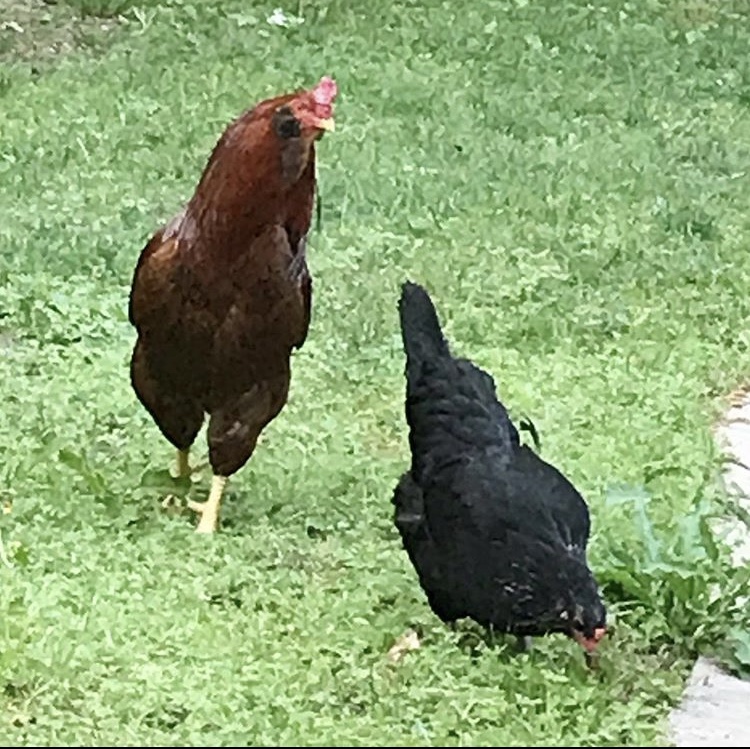
I have only bought one rooster. He came with my first flock of 3 hens. His name was Roo. He was the most chivalrous boy ever, always finding treats for the ladies and calling them over. He also bravely sacrificed himself when our neighbor’s dogs attacked the flock while free-ranging. Luckily, his tail was the only casualty. Those beautiful feathers did eventually grow back.

My next rooster came from a friend at work. At that time, all of my girls had Italian names. It was the idea of one of my patients to name them like this, for I already had one named Isabella, the lone survivor from my first flock.

I did a quick Google search for Italian baby boy names and got as far as Alfredo, giggling at the thought of a rooster named Chicken Alfredo!

He was also a great rooster and took care of his girls. So much so that he really did sacrifice himself for them. 

Now I had an opening for another rooster. It wasn’t long before one found his way to my flock. A friend of a friend had an Araucana rooster, which is a bit of an unusual breed. The hens of this breed lay blue eggs. This was Sir Fluffy. 

I haven’t kept chickens since 2018. I stopped when I went vegan, keeping my last two, who were very adept at climbing out of the protected run until one day. a hawk found them. It was a sad day. 

So I’ve had an empty home for chickens ever since. Although I have no interest in keeping hens for their eggs, the thought of rescuing roosters to keep them off the dinner table is appealing. 

I recall that on one of my community’s vegan pages on Facebook, there are local residents who keep bachelor flocks. Apparently, as long as there are no hens around, the boys will play nicely with each other. 

A truck transporting chickens to slaughter. So sad. Photo by author.

I do miss having chickens. They are such interesting creatures. And I wonder what would happen if I adopted a few roosters to live out their days peacefully. 

My real children and I discussed this. The question was asked: 

“What if we had a flock of hens and kept the boys separate, kind of letting one rooster take turns spending time with the hens?”

“You mean, like brother husbands?”

We had a good laugh over that. 

___________

Still contemplating this possibility, and I think it would be awesome to spare some rooster lives. Plus, chicken boys are so pretty! 

As always, I hope you all are safe and healthy.
A Gen-Xer’s Perspective on Surviving Early Motherhood

It takes a village

I’m at a stoplight. I haven’t been driving alone since my baby was born, but I guess I must return to real life at some point. 

Guilt is my overwhelming emotion right now. Tears stream down my cheeks, and I wonder how they let me become a mother. I’m terrible at this. 

She screams constantly, nursing has been an adventure in learning failure, and I’m completely inept at consoling this child I so desperately wanted. 

The thought occurs to me that I could simply let the car roll through this red light, and my life could be over. My husband would be left with my life insurance, and my daughter would never be able to figure out for herself what a terrible mother I really am. 

The only thing that stops me is the thought that I might hurt someone else in the crash. 

This was my inner dialogue in my first few days as a mother. 

In my sleep-deprived brain, the thoughts that swirled were self-defeating, admonishing my lack of mothering skills.

It’s astounding that the most natural of roles as a woman, that of a mother, should come with the highest expectation of perfection. Society has taught us that we should instinctively relish this role, know what to do, and find pure bliss in nurturing this life that we grew in our bodies once we have birthed them.

So why did my brain betray me so awfully? Why did I feel like such a miserable failure in this role which was supposed to come so naturally? I don’t have the answers to these questions, but the pain of not knowing any solution was such that I decided not to have a third child. 

Granted, the second pregnancy began with the understanding that this emotional turmoil would be the result, and I had greater confidence in my mothering skills that second round. But the doubts were still there, still percolating under the thin veil of competency as a parent. 

I found myself jealous of my husband who is known in our group of friends as the “baby whisperer,” with the uncanny ability to settle down any infant in any state of crisis. I can recall many, many nights when he held one of our girls on his chest as they both slept, exhausted, on our living room sofa. I was not blessed with this same power to calm little ones. 

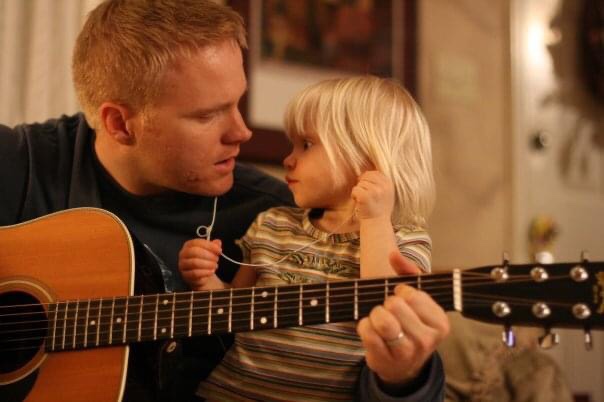
My husband often entertained our second daughter by playing music. Photo by author.

My husband also seemed to know that I was struggling, trying his best to do what he could to make my burdens lighter. When the babies woke up in the night hungry, he got up and brought them to me to be nursed. He fully participated in diaper changing, bathing, feeding, playing with, and reading to our babies. 

Now in my late 40s, I look at my female colleagues beginning families and I give advice that may be different than what they might hear from others. I urge them to find little moments for themselves, to not abandon the women they were before they were mothers. 

In buying gifts for new mothers, I tend to lean toward items for her, not the baby. Baby stuff is adorable, for sure, but the moms need comfort and items that remind them that they are still a person separate from this other life they began. 

I recently gave a pregnant colleague a bottle of wine for after the baby is born. She had lamented how much she missed red wine one of the last times we worked together. I understood. 

While growing babies, mothers make tremendous sacrifices to ensure the health of this precious life they are growing. It’s so hard to give up caffeine, that occasional glass of wine, and certain foods. My husband bribed me to push with the promise of a cold Coca-Cola once our daughter was born. This often doesn’t change much once the baby is born if you are nursing. 

If this is your plan, you are essentially giving two years of your body to growing a child, as it’s recommended that you nurse for at least a year. A man’s essential role only lasts a few seconds. The bodily burden for women is magnanimous in comparison. 

My husband would argue that his role was much more important than that, and he’d be right. But that’s because he chose that path, not because it was biologically necessary.

I nursed my babies at a time when it seemed “granola” and was not yet socially accepted. My work asked me to pump in the bathroom that our patients used. Gross, right? They reasoned that it’s a bodily fluid. But I’m feeding what I’m expressing to a child, not flushing it down a toilet.

I was only allowed to pump during my 30-minute lunch break, during which I also had to feed myself. Which meant extra planning and no cafeteria meals for me. I didn’t have time to add that to the 20 minutes it already took to pump, leaving me with only 10 minutes to eat. And nursing moms are ravenous. 

Now there are laws to protect nursing mothers. They have to be allowed a place to pump and time to do so in their days. I’m grateful for the changes, and I’d like to think that my generation paved the way to make life easier for new moms who work. 

Because on top of the burden of returning to work, you shouldn’t also have to struggle with how to relieve your engorged breasts and excrete enough milk to feed your baby in your absence.

The overwhelming feelings of guilt from multiple factions as a new mother are so very real and can be completely defeating. 

What’s even worse is that moms can be truly cruel to each other. Why in the world would moms play such a dangerous game when we are all just doing the best we can? 

Those moms lucky enough to have husbands who have lucrative jobs who can then stay home with their babies make working moms feel guilty for leaving theirs. 

Moms who have to work make stay-at-home moms feel simple for taking on that traditional role, even though many of us secretly wished for that precious time with our babies. But two-income households are almost necessary in this economy, even if you barely make more than what daycare costs. 

I remember sitting with my newborn first daughter in a rocking chair in the infant room in the daycare where we had made a deposit. I nursed her right there in that chair. And in the 30 minutes we existed in that space, I observed things I didn’t like. And I wept. 

I came home crying to my mother-in-law that I couldn’t do this. She understood, and somehow we patched together trusted caregivers to ensure that our baby was well cared for. We continued to rely on this network when our second daughter was born. I’m forever grateful to not have to rely on a daycare. 

This was my village. It was a great one. And that may be what is missing in parenthood these days. We have abandoned this notion of multigenerational upbringing. My kids had that to some extent, and I count myself blessed. My kids had such a great foundation of love in their formative years, only part of which came from me. 

If it wasn’t for my village, I don’t know if I could have made it through those infant and toddler years. This includes my husband, my in-laws, a woman who also changed my husband’s diapers when he was a baby, and a few trusted friends. 

A photo of my father-in-law holding my older daughter as a newborn. Photo by author.

I’m so very glad those days are behind me. As I watch my colleagues struggle to raise their families, I don’t miss those early days. Sure, there are wonderful memories from each stage of raising my girls, but I also am in love with the adults they have become. And they may not be the strong women they are now without that ever-important village. I know I would not have survived early motherhood without this. 

___________

Often I feel as though my daughters became great adults in spite of me, not because of me. I certainly hope they forgive me for all of the mistakes I have made as a mother. Unprocessed trauma does not make for sensible parenting. I wish I had begun that part of my journey a lot earlier than I did. Perhaps my bouts with postpartum depression would have been more manageable. Does any of this resonate with you? 

As always, I hope you all are safe and healthy. 
Pink Is the Color of Strength

It’s no longer a demure color for me

I’ve learned so much about the color pink over the years. I don’t think of pink as delicate and demure. There is no name for pink like “blush” and “bashful” for me. Pink is a color of strength, and here’s why:

My running team is called the Pink Nation. I’ve been running with them for 6 months of the year for 10 years now, coaching since 2019. We are a novice marathon training team. 

Novice is a bit of a misnomer, as several of our members have run multiple marathons like me. Novice indicates more of the miles you are willing to run in a training season. I prefer running on the lighter side of mileage, but this is over 500 miles in a season, which is still impressive if you ask me. 

I love my team. I love coaching. And I love helping new marathoners reach their dreams!

The pink flamingo is one of our mascots, and it’s fitting that this year, the world witnessed the strength of these majestic birds as they rode the winds of a hurricane and found new places they have never explored in North America.

Although pink has been deemed a feminine color by society, my team views it a bit differently, as marathoners are among the toughest athletes mentally.

The coaches take turns giving the benediction, our name for our pre-run pep talk, each week. This week was again my turn, and here’s what I told my team:

The Joy of Pink

I struggled a bit to find inspiration for this week’s benediction. But then I found it in the most unusual place. I’ll explain that part in a bit. 

What does it mean to be pink?

As a team, we have practically branded it. 

We have our own hashtag from the phrase:  

BLOOD + SWEAT = PINK

We hijacked a slogan from Mean Girls and made it our own:

ON SUNDAYS WE WEAR PINK.

Lisa has made sure that we have the most amazing merch to proudly declare ourselves members of this team. 

And we have run so many miles together, living our mantra:

ALL GO. NO QUIT. COWBOY UP!

We made pink cool long before the Barbie movie made it en vogue again. 

Pink is special. This team is special. All of you inspire us as your coaches to come here every week and help you work toward your goals. 

And as a former gymnast, I’m following the World Gymnastics Championships and USA Gymnastics closely. 

That’s why I loved that the ladies wore hot pink leos for their podium training for the World Championships.

And this quote from their social media inspired me to talk to you about the meaning of pink:

“Pink is the color of strength, a color of conviction, a color of decision making.”

So true, right? We are so excited that you chose to join us in this journey. I’m so glad you all are a part of the Pink Nation! 

Enjoy this fallback week and this amazing weather! Let’s bring it in… 

ALL GO! NO QUIT! COWBOY UP!

Coach Anne

It was great weather, indeed. Sunny skies, crisp air. It stayed cool until the very end of the run. 

Although the mileage was supposed to be only 12 since it was a drop-back week, the route was long at 12.6 miles, and I had to add on a bit to find a public bathroom. (Thank you, Hardees, for the use of your facilities!)

I ended up with 13 miles. Why? Because when I got back to my car, the mileage on my Garmin said 12.89. It seemed silly to end there. I ran to 13, just like any other type-A runner would. 

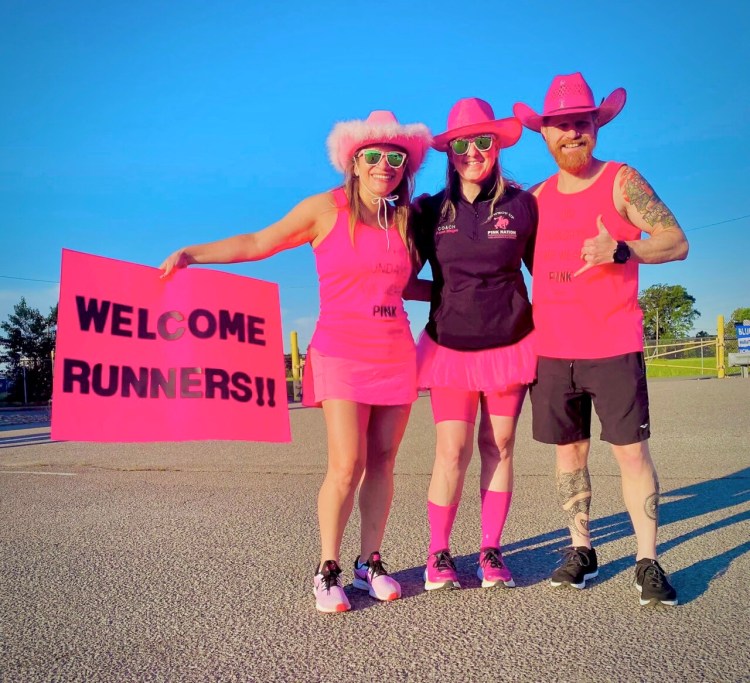
With two of my fellow coaches on opening weekend of training one year. Photo from author’s archives.

And after the run, I went home and streamed the qualifying round for USA Gymnastics in the World Championships. The women did not disappoint, with Simone Biles adding a new, perilous vault to the list of skills with her namesake. And Shiliese Jones with an impressive second place in the all-around, with Simone first, of course. 

I’m so excited for and inspired by USA Gymnastics right now, and I can’t wait to see how this week plays out. Simone seeks redemption, and I’m here for it!

Do you want to follow along? You can see routines, updates, and live streams here: https://allgymnastics.tv/

___________

Do you love the color pink? Do you love USA Gymnastics? I’d love to hear about it!

As always, I hope you all are safe and healthy. 

Do We Shame Sex Because It’s Animalistic?

Maybe it’s time to change the conversation about sex

I was thrifting the other day and found a book entitled The Secrets to Tantric Sex. The title alone made me blush. I looked over my shoulder to see who might be around, and, seeing no one to judge me for my curiosity, pulled the title from the shelf to take a better look.

Although I briefly considered purchasing the $1.98 gem, upon perusal of the carefully diagrammed pages, I decided I was indeed too much of a prude to go through with it. My husband, however, may have been impressed if I had. I would have been mortified to bring that title to the register for purchase. 

There was an important word I used in that story: PRUDE. Yes, I said it. I’m a prude. Not because I don’t enjoy intimacy with my husband, but because I was raised in the church. The lessons from purity culture run deep, almost as if feeling shame about sex is in my DNA.

Just as your body begins to develop, your hormones rage, and you begin to feel strange around people you find attractive, you learn through purity culture lessons that all of these very natural feelings are wrong. All of those butterflies stirring in your nether regions are to be squelched; those thoughts are dirty. Sometimes even the process of puberty is kept a mystery, as if denying that it is happening will keep the inevitable changes at bay. 

Even masturbation is taboo in purity culture. My dad, who earned a master’s in theology, used to love to tell a story about a preacher from one of the church camps he attended. The pastor fervently commanded that boys not touch themselves, or their children, and their children’s children would be cursed with infertility. Hmm… how does that work exactly? It all sounds very scientific, eh?

All of this is bad enough if you happen to fall into the most common genetic variety and like the opposite sex. But what if your biological makeup is different? What if you diverge from this heterosexual expectation? The church can make you feel even more ashamed, especially if you are in a religious sect that teaches that anything other than a union between man and woman is sinful. 

Sex education outside of the church is often not much better. And although there’s the ritual of the 5th-grade movie that your parents must opt-in for you to see under most circumstances, some public education systems teach abstinence-only curriculum. Some school systems, including my own county’s, have more members of the clergy on their sex education committee than doctors or mental health professionals. Shocking, right?

Keeping sex and sexuality a thing of shame is damaging to fragile tween and teenage egos. Making religion a part of secular, public education is wrong.

There is now a concerted effort by right-wing conservative groups to ban any books in school and even public libraries that they deem “sexually explicit,” the guidelines of which are intentionally vague. Again, where is the separation of church and state?

Some aspects of purity culture leech out into general societal views of sex as well. Men are studs if they have sex frequently. Women are considered sluts or whores if promiscuous. Furthermore, consent is generally viewed as given if a woman dresses a certain way, is too nice, or is simply in the wrong place at the wrong time alone.

Purity culture is rape culture.

But why is it that men are celebrated for their sexual vigor and urges, and women are shamed for the same? No one wins in this system, because men are shamed for being gentlemen, and women are shamed if they give into the lust of men. 

Lust is a great word to use here, because sex is, well, so primitive

Of all of the characteristics of being human, our sexuality is the least controllable. Maybe it’s the lack of control that seems so primal as if we need to prove we are better than animals by consciously managing these urges.

Does this explain the rash of clergy who have been credibly charged with molestation of children? How ironic that those who shame us the most for sexual desires are often the most guilty of sexual acts performed without consent.

But sex doesn’t have to be ugly. It’s also an expression of love and affection.

Read any romance novel and authors will describe the intense chemistry between lovers, desires that need to be satisfied, and blissful unity when couples finally consummate their feelings. Julia Quinn who authors the Bridgerton series of novels preserves the virginity of her protagonists until at least engagement, keeping that veil of innocence for as long as it makes sense to do so. 

Biological urges to reproduce, or at least practice the act thereof, are as essential to humanity as the hunger for food. To deny that this is a part of the human experience would be preposterous. 

Yet how often are we told to ignore these traits? Certainly, we need to have conversations about consent, but we also need to understand that it’s natural to want to express our humanity and affection through sexual acts with another person. It simply is what it is. 

By trying to ignore this fact, it makes the mysteries of sex and sexuality all that more intriguing and compelling. But if we were to just accept that it’s a part of human nature, maybe we wouldn’t struggle so much emotionally. As long as our sexuality isn’t harming someone else, why should it matter?

When it comes down to it, our species is still a part of the animal kingdom. That’s the simple truth. And sex is simply a part of being an animal.

___________

Lead photo: a wolf howling, perhaps as a call to its mate.

Does any of this resonate with you? I’d love to hear about it!

As always, I hope you all are safe and healthy.
Quotable Quotes for $200, Alex!

Gloria Steinem edition

I do love a good memoir, and I recently picked up a great one. Not only did I gain the perspective of a celebrated feminist, but also what it means to foster change by listening to others and gaining empathy. Plus I found a gem of a quote like this one: 

When humans are ranked instead of linked, everyone loses.

Gloria Steinem

This is one of my favorite quotes from her book My Life on the Road. It really does express a concise and valuable assessment of what is wrong with society. 

I’ll begin explaining this quote with something I teach all of my clinical students as a hospital-based physical therapist. It’s important to emphasize that everyone who works in the facility is important. Just because you have more education and make more money than the folks who clean the floors or deliver food to the rooms does not mean they are any less valuable to our work as a team. If the floors aren’t clean or my patients don’t get fed, it makes my job as a clinician that much more challenging. We say “Hi!” to everyone. We treat all of our colleagues with respect. Everyone’s role is valuable. 

If we look at the greater society as a whole, it’s really not that much different. 

As I pass unhoused people living under a bridge to I95 on a morning run with my training team, I don’t consider them lazy or less than human. I try to understand how they got to this point in their lives. In this particular stretch of underpass, it seems like the nursing home area. Everyone has a rollator or walker, and they sleep close together to protect each other. 

Imagine if this was your life. 

How do we fix the systemic issues that allow the ranking of our fellow humans? 

This is the method the world at large used to allow for atrocities like Jim Crow laws and segregation, the Holocaust, and multiple other instances of genocide. Blaming those who are different for the faults of society is cowardly and doesn’t solve any problems. Yet this playbook gets action repeatedly.

When we view others as less than human, this is when we fail morally as a society. 

Why is it that humans expect everyone to assimilate to a white, male-led world? How can we dare discriminate due to factors beyond our control? Yet, as human observers, we celebrate the uniqueness and diversity of the animal kingdom. 

Let’s look at birds, for instance. 

In the city, we see lots of sparrows, pigeons, starlings, etc. You may have even heard people refer to these as “trash birds.” You know, nothing special. But when you see something unusual, say, a blue jay, a woodpecker, or maybe even something as special as an indigo bunting, we ooh and ahh. 

Not only that, but all of the males in the bird kingdom are more beautiful than the females, and they have to work to earn a mate. In the human world, it’s the females who take this role. It seems extraordinarily unfair. 

So why don’t we celebrate people who are not the norm? Why do we discriminate and “rank” others as less than deserving of equality because they fall outside what is common for people?

Taking socioeconomic status out of the equation, we can look at race, sexuality, height, gender, intellectual ability, physical ability, and neurodivergence among distinguishing traits. Sure, in some instances, these characteristics are celebrated. But definitely not always.

Imagine how stale our world would be if we all looked alike, thought alike, and acted the same. 

It would be boring, for sure. And innovation would certainly die.

We should celebrate our differences as gifts. We should respect each other’s places in the world as equally important. 

Except this isn’t our reality. We fight over the things that exclude us from each other, like religious beliefs. Countries and people fight over resources. There are very ugly parts of world history about colonialism and imperialism as Western nations sought to gain more territory. 

We punish those who are poor because society paints a picture that makes it seem like it’s their fault they are economically disadvantaged. They’ve committed some moral failure which means they will not be rewarded by society. Yet much of the time, it’s systemic issues and predatory laws and practices that keep poor people poor. 

We paint more primitive societies as savages who need to be saved, when in reality, their culture may function just fine for them. Is it really our business to convert them to Western ideals? 

One can only hope that in the ranking of the world, you are higher up than your neighbor, for you will inherit many privileges. This is reality. But what happens if you aren’t one of the lucky ones? Is that fair? Is that respectable? Is that moral? Absolutely not.

Gloria Steinem skillfully evaluated humanity in this quote. We do truly fail as a society when we rank the importance of others. For this world to succeed, we need to begin to help one another, respect each other, and celebrate diversity in human nature. Or else we are no better than any other animal on the planet.  

___________

Did any of this strike a chord with you? I’d love to hear about it!

As always, I hope you all are safe and healthy.